
This article was written on July 30, 2022
Hello? This is Jooyoung Kim, a mixing engineer and singer-songwriter.
In this orchestration basics, we will not cover much about arrangement or composition, but will mainly talk about instrument theory. Today is the first chapter on string instruments.
- Strings
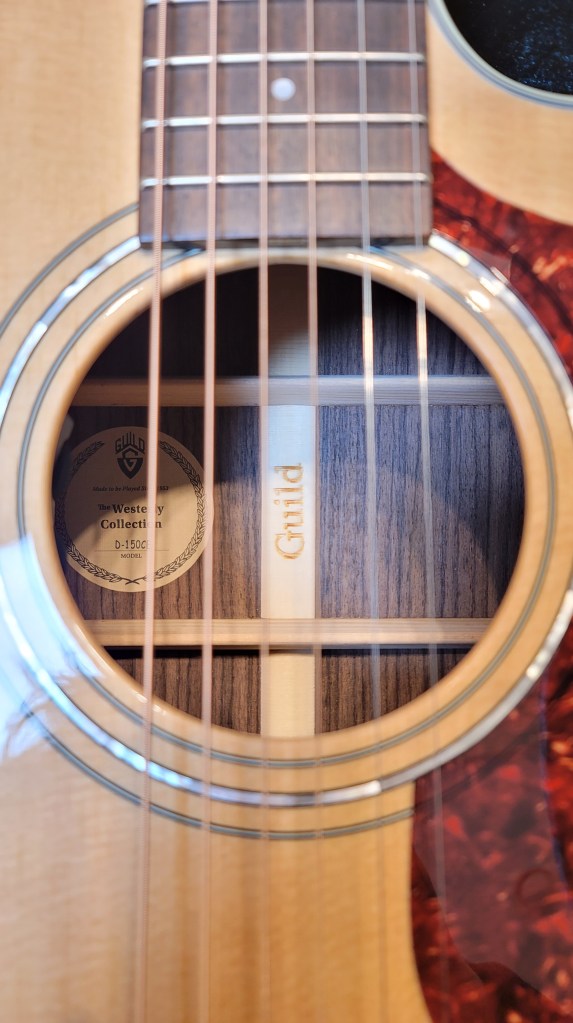
There are many musical instruments that use strings to produce sound. The piano is also an instrument that makes sound by hitting metal strings with a hammer, the guitar is an instrument that makes sound by plucking the strings, and the violin is an instrument that makes sound by rubbing the strings.
We can call them all string instruments.
However, in an orchestra, strings mainly refer to the violin family that makes sound by rubbing the strings.
Therefore, in the ‘Orchestra Basics’ article, please read the article as if the word ‘Strings’ refers to violin families.
- Characteristics of the violin family
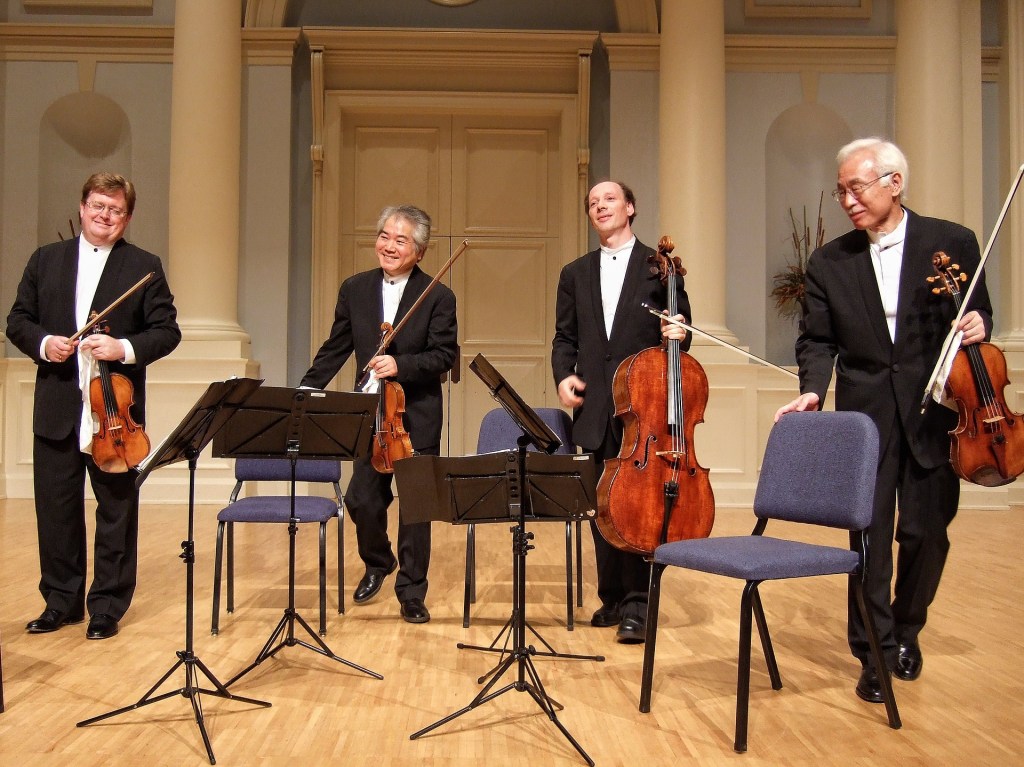
1) It consists of 4 instruments: Violin, Viola, Violoncello, and Contrabass.
2) Each instrument has a total of 4 strings (Contrabass also uses 5 strings), and the playing techniques are similar.
3) It has the largest number of members in the orchestra, making up more than half of the members.
4) All together, it has a wide range of about 7 octaves, which is almost similar to that of an 88-key piano, which is about 7 and a half octaves.
5) Delicate expressions are possible.
6) Compared to wind instruments, there is less fatigue, so you can play for a longer period of time.
Because of these characteristics, it is used as a central part of the orchestra and plays such an important role.
- Structure of violin
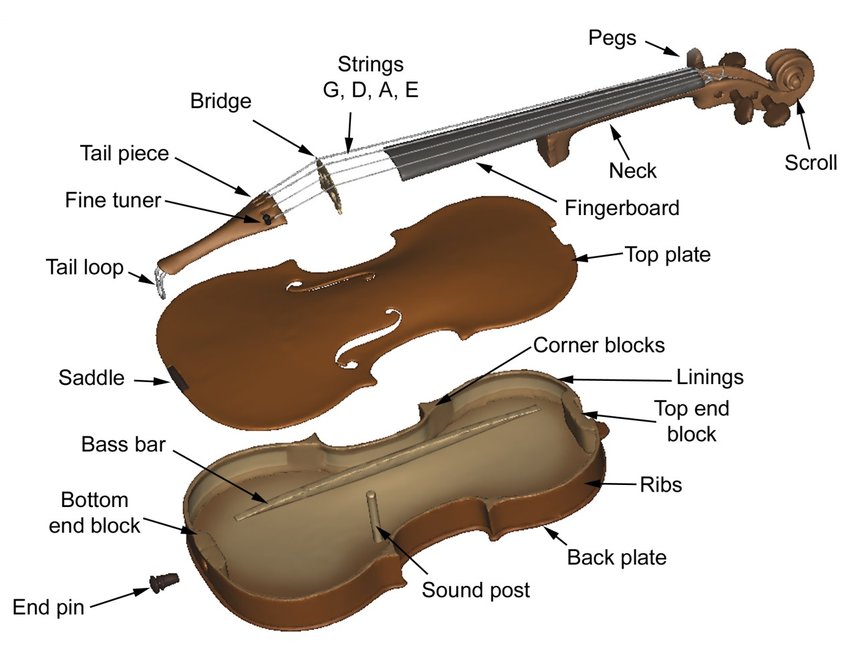
Anyone who has played guitar will know that the structures are quite similar. Like a guitar, playing from the bridge side produces a harder sound, and playing from the neck side produces a softer sound.
Additionally, the fingerboard is not flat but has a curvature, so when three or more strings are played simultaneously, an short arpeggio-like effect can be achieved due to the natural time difference.
Cello and contrabass do not have a chin rest, but instead have a long bottom end pin, which acts as a pillar to support the instrument from the bottom.
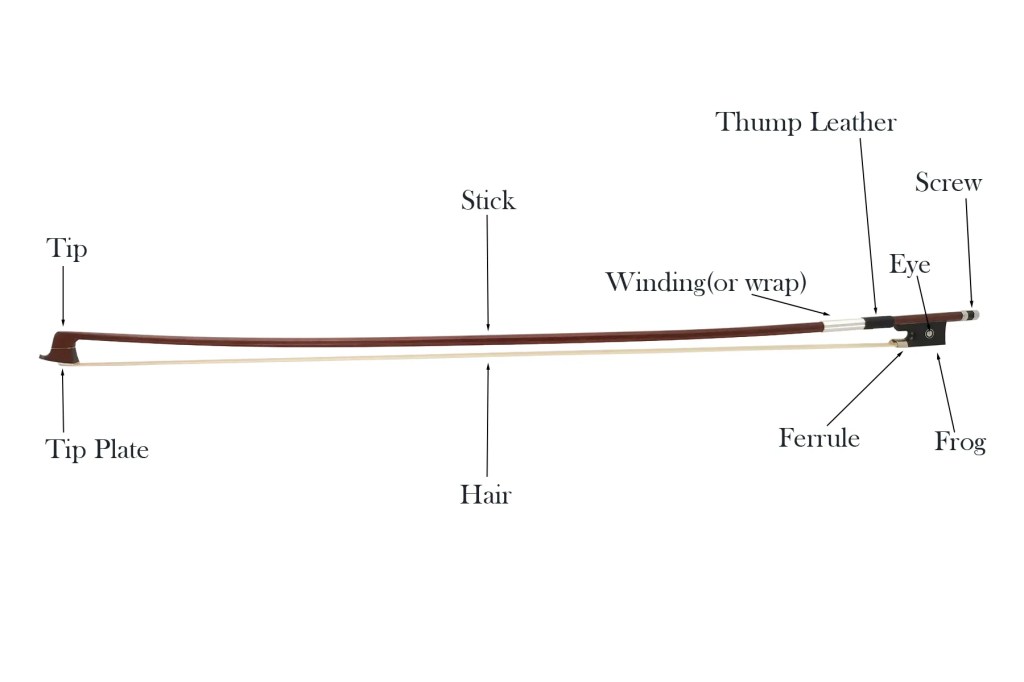
The upper part of the bow is called Tip and the lower part is called Frog, and the Up bow and Down bow signs come from this shape.
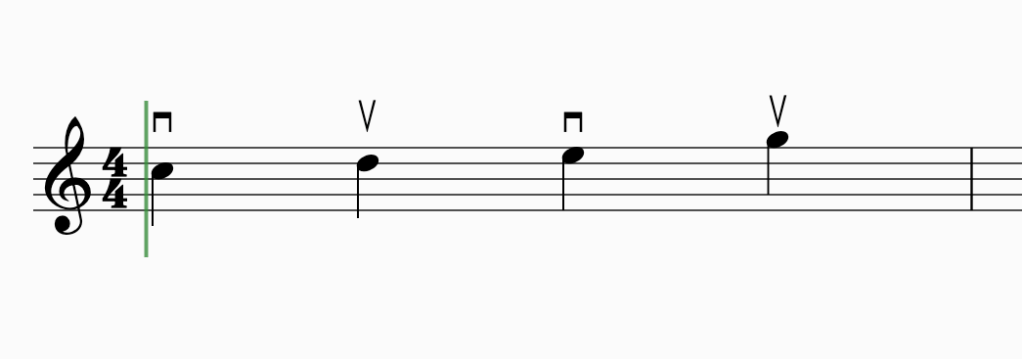
The guitar also adopts this same method and indicates the up stroke and down stroke in this way.
The closer you play to the Frog, the closer it is to your hand, making the sound stronger. The closer you play it to the Tip, the softer the sound becomes, as it moves further away from your hand.
- Open strings and positions
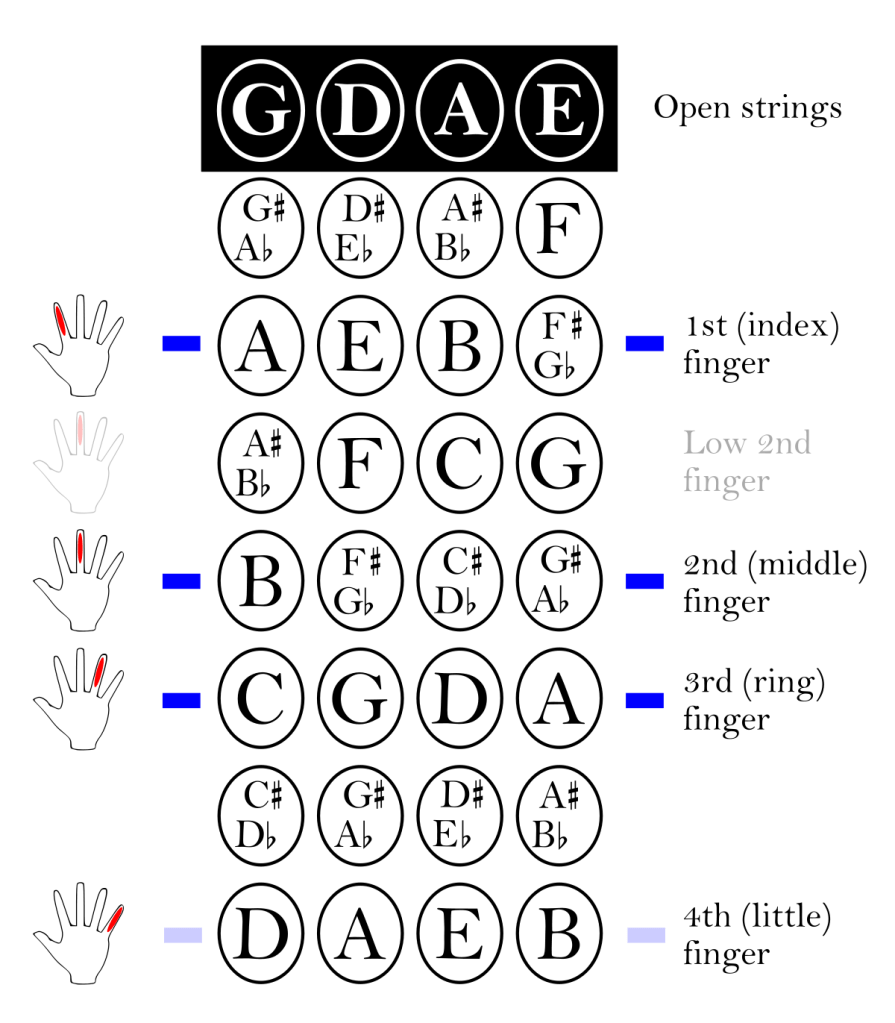
Violin – G3, D4, A4, E5
Viola – C3, G3, D4, A4
Violoncello – C2, G2, D3, A3
Contrabass – C1 (if 5 strings), E1, A1, D2, G2
Position refers to where you place your finger on the fingerboard. I will omit the detailed explanation because it is difficult to explain in writing. These days, we use virtual instruments, so there is no need to know the details..^^
If you have an understanding of open strings and positions, you can write songs by distinguishing whether they can actually be played or not. Determining whether or not you can point out a chord with your fingers is a very important and basic factor when using chords in actual performance.
However, there is a formula that allows you to easily determine this even without understanding the position of the string instrument. I will explain this formula when I explain how to play string instruments in the next article.
Have a good day!

 Jooyoung's Music Blog