Hello, This is Jooyoung Kim, a mixing engineer and singer-songwriter.
To mix effectively, you need to listen to sound accurately.
What does it mean to listen to sound accurately? It can be a long discussion, but let’s focus on two main points:
- Minimize distortion (from the room, objects, speaker baffle, speaker unit limitations, etc.)
- Listen from the correct position.
These two principles form the foundation.
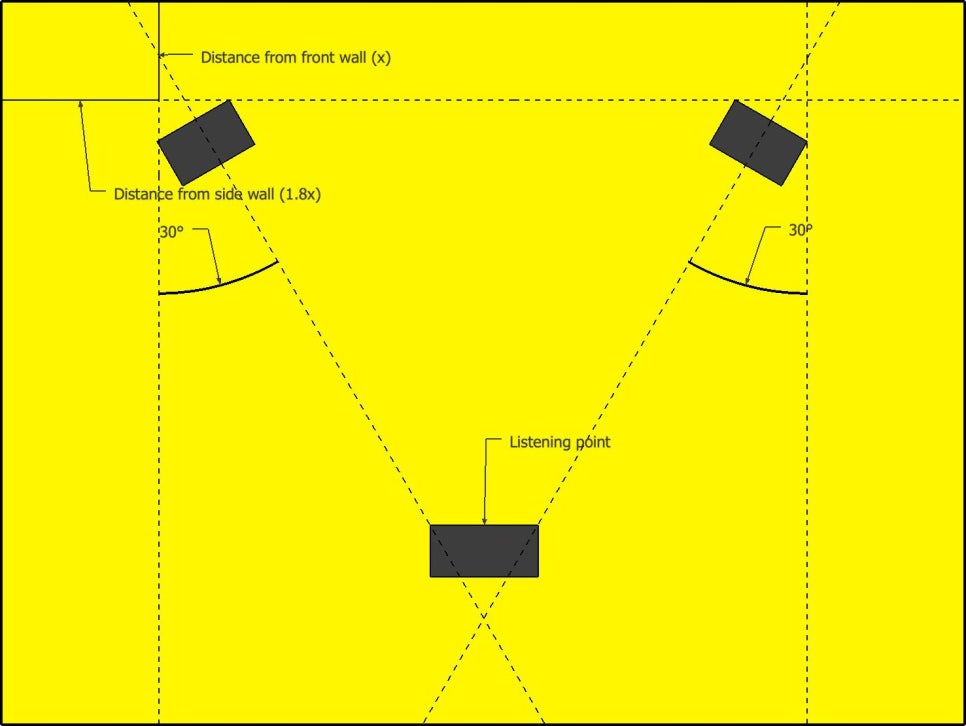
Generally, stereo speakers are arranged in an equilateral triangle. The angle marked as 30 degrees in the diagram above is called the Toe-In Angle. This angle can be adjusted slightly based on personal preference.

Additionally, the tweeter, which reproduces high frequencies, should be positioned close to ear level. This is because high frequencies are more directional and may not be heard well if the tweeter is placed too high or too low. Various stands are used to achieve this positioning.
However, recommended angles and placements can vary by manufacturer, so it’s best to start with the manual and then adjust as needed.
When changing placements, it’s important to measure and identify where the issues are. With some training, you can listen to a track and identify boosted or cut frequencies, giving you an idea of where the problems lie. Measurement, however, makes it easier to pinpoint specific issues you might miss by ear.
One of the simplest and free measurement programs is REW (Room EQ Wizard), which I introduced a long time ago.
You can use an affordable USB microphone like the miniDSP UMIK-1 for easy measurement, or, if budget allows, a measurement microphone like the Earthworks M50.
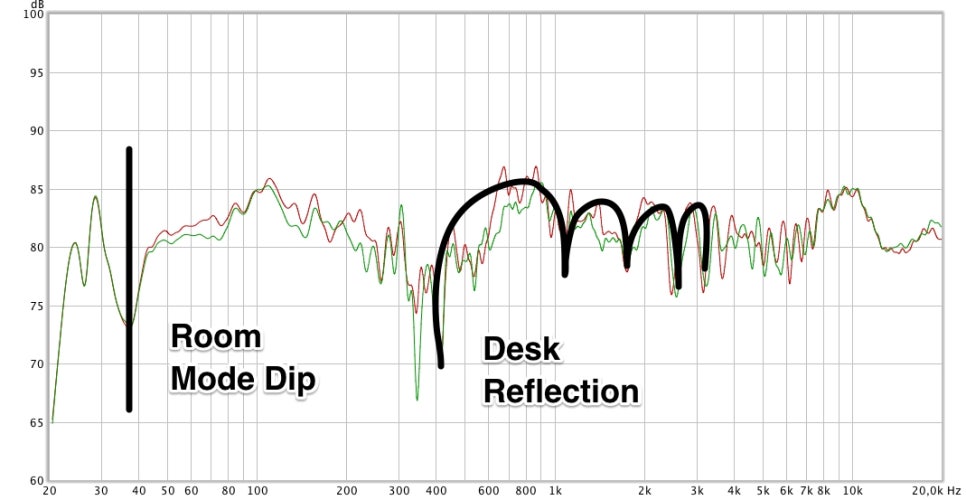
By measuring, you can understand various factors beyond just frequency response, such as phase, harmonic distortion, and reverberation time. This helps you identify and solve problems in your workspace.
Doing all this ensures you hear the sound as accurately as possible, allowing you to understand what proper sound and mixing should be.
So, you’ve set up your speakers correctly. How should you listen to the sound?
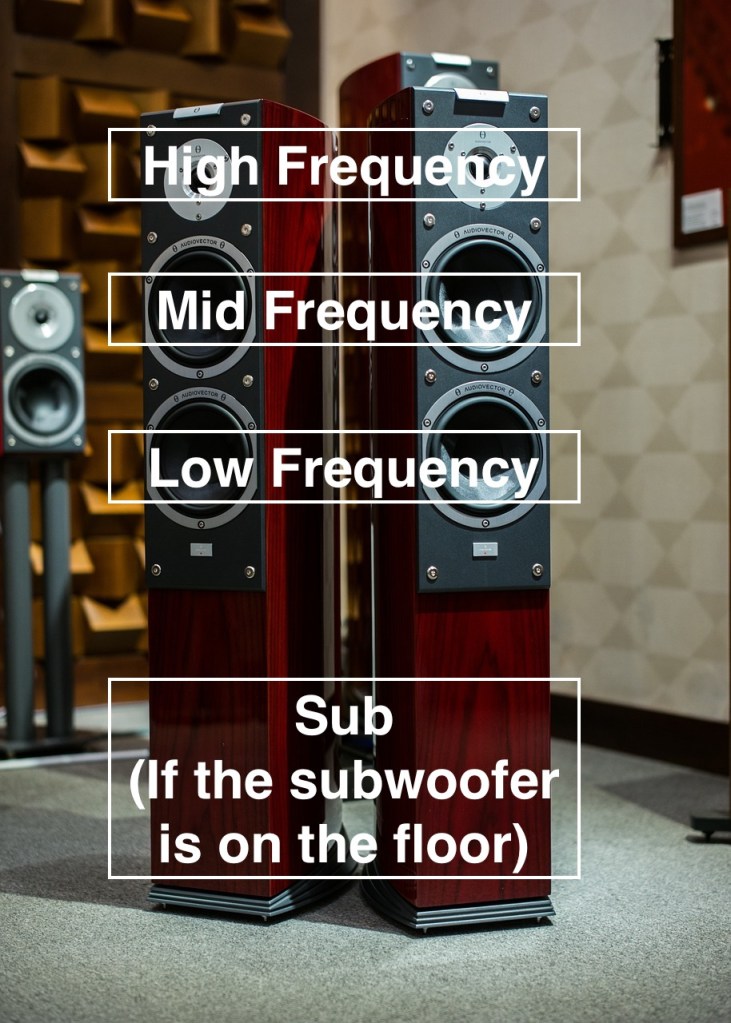
Of course, you listen with your ears, but I’m not just saying that. I’m suggesting you listen to the sound in layers.
In a typical 2-way speaker, the tweeter is on top, and the woofer is on the bottom, so high frequencies come from above and low frequencies from below. Consequently, low-frequency instruments seem to be positioned lower, and high-frequency instruments higher.
If your listening distance and room support it, well-made hi-fi tallboy speakers can make mixing easier.
That was about the vertical plane. Now, let’s talk about the front-to-back dimension.

When someone whispers in your ear versus speaking from afar, there are noticeable differences:
- Whispering sounds clearer (more high frequencies, less reverb)
- Whispering sounds louder.
These principles determine whether instrument images appear in the front or back. Panning also moves them left and right.
If you’re not familiar with this concept, try closing your eyes and identifying where each instrument is located in a mix.

Since stereo images vary with different speakers, it’s crucial to understand how your speakers reproduce images. Reference tracks are essential for this.
For example, I always listen to Michael Jackson’s albums and the MTV live version of “Hotel California” when I switch speakers. Michael Jackson’s songs are well-mixed for their age, and the live version of “Hotel California” is superbly mixed except for the vocals.
Let’s wrap it up for today. Creating the best acoustic environment in your room is essential for effective mixing.
My environment isn’t perfect either, but I’m continuously improving it..!
See you in the next post!

 Jooyoung's Music Blog