
This article was written on January 12, 2023.
Hello? This is Jooyoung Kim, a mixing engineer and music producer.
It’s already been almost a month since I wrote Woodwinds(1)… I’ve been so busy these days that I’ve been spending time just thinking about it, but after seeing a comment from a subscriber saying that he was enjoying it and that he was waiting for it, I cheered up and wrote this article… haha.
So, let’s get started right away!
- Flute & Piccolo

The flute we generally think of is the Western Concert Flute, which is an instrument based on the key of C. Additionally, the Piccolo is about half the length of the Flute and sounds exactly one octave higher.
Piccolo is a transposing instrument whose notation and actual sound differ by one octave.
In addition, the Alto Flute is also often used. It is a transposed instrument whose actual sound is a full 4 degrees lower than the notated sound, and is also called a G-key instrument.
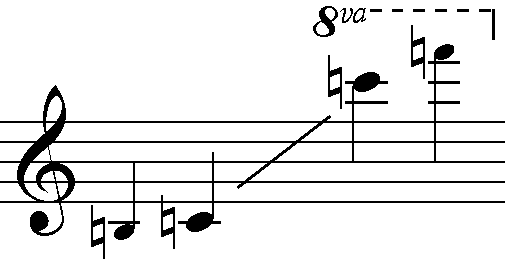
Because the sound of the piccolo is high and small, it is often used together with the flute for doubling, and in most cases, it is not used independently. You can think of it as similar to the relationship between Cello and Contrabass.
The flute is in charge of the soprano among woodwind instruments, so it produces the clearest and highest-pitched sound.
Therefore, in general orchestration, the notes above the lines on the staff are mainly used.
- Oboe
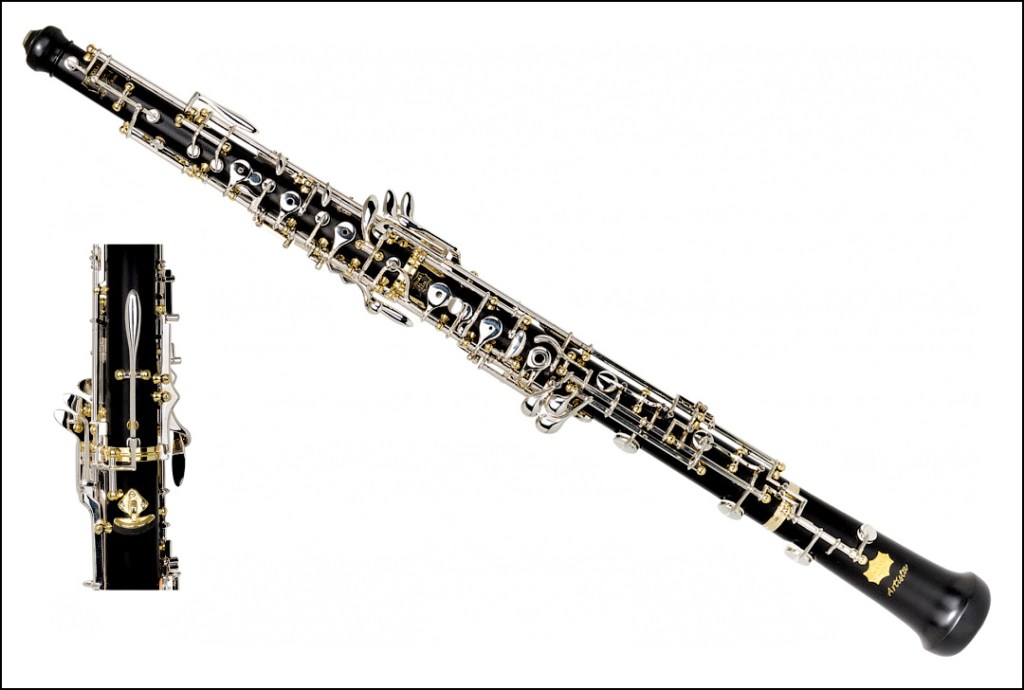
Oboe is often made of ebony or rosewood and is dark in color.
It has a very strong melodic character, making it difficult to use as an accompaniment instrument, and its tone is unrivaled. Therefore, in orchestration, when an interesting dissonant interval such as an augmented fourth is required, it is almost always used in the Oboe.
As a side note, in the final exam for the orchestration class at the school I attended, points were deducted if the augmented fourth was placed on another instrument instead of on the oboe…^^;;
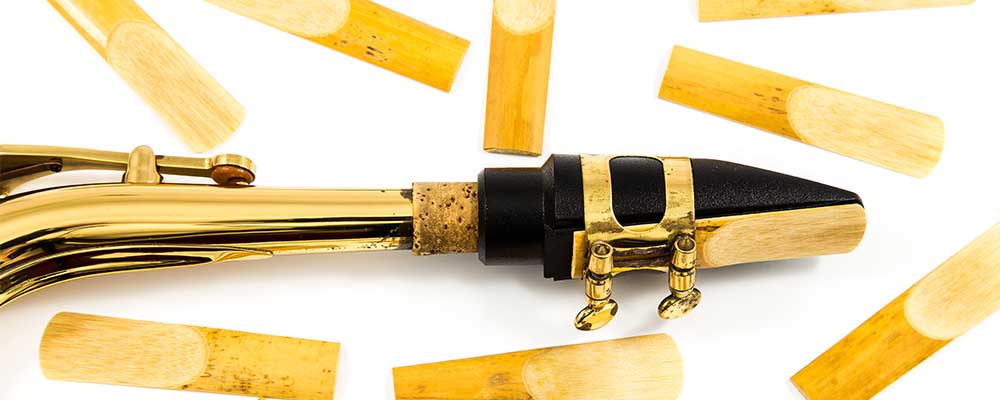
Also, it is a double reed instrument that uses two reeds, and one of its characteristics is that it is difficult to play.


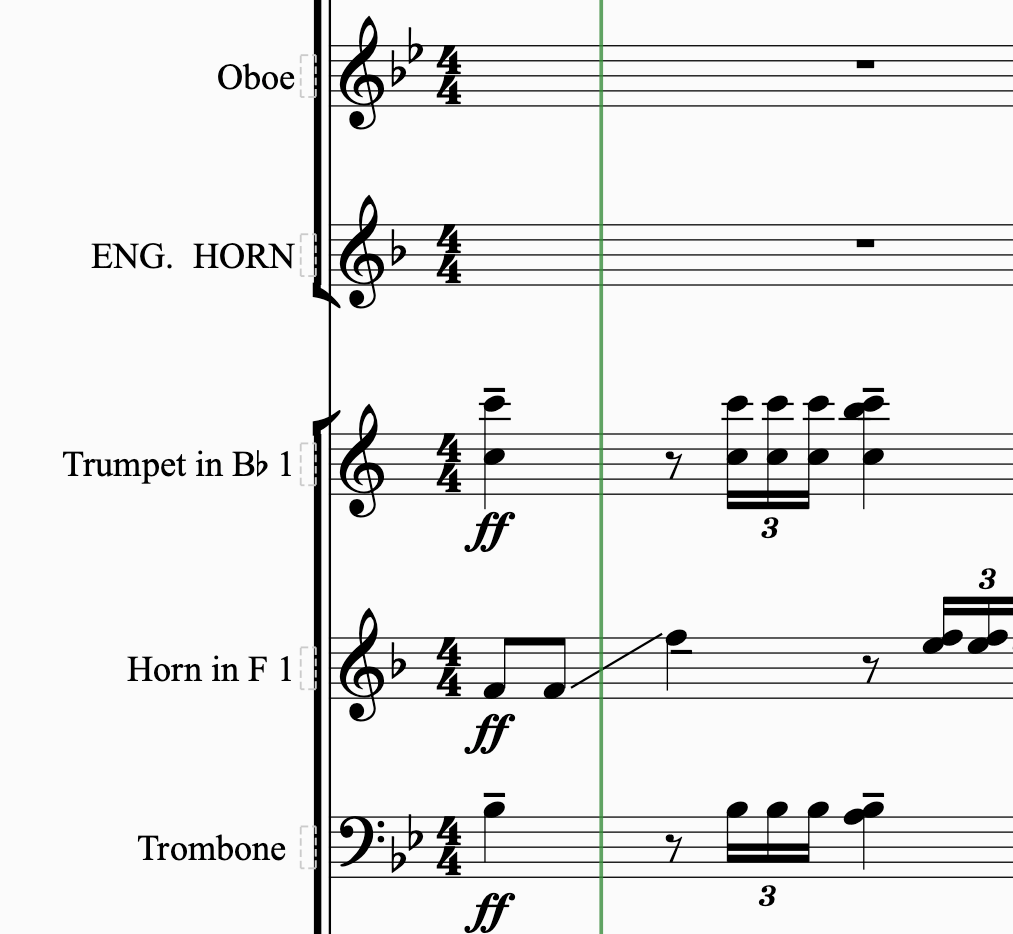
The English Horn (Cor Anglais) is the most commonly used Oboe instrument. It is an instrument in the key of F, a perfect fifth lower than the Oboe, and similarly, the actual sound sounds a perfect fifth lower than the notated sound.
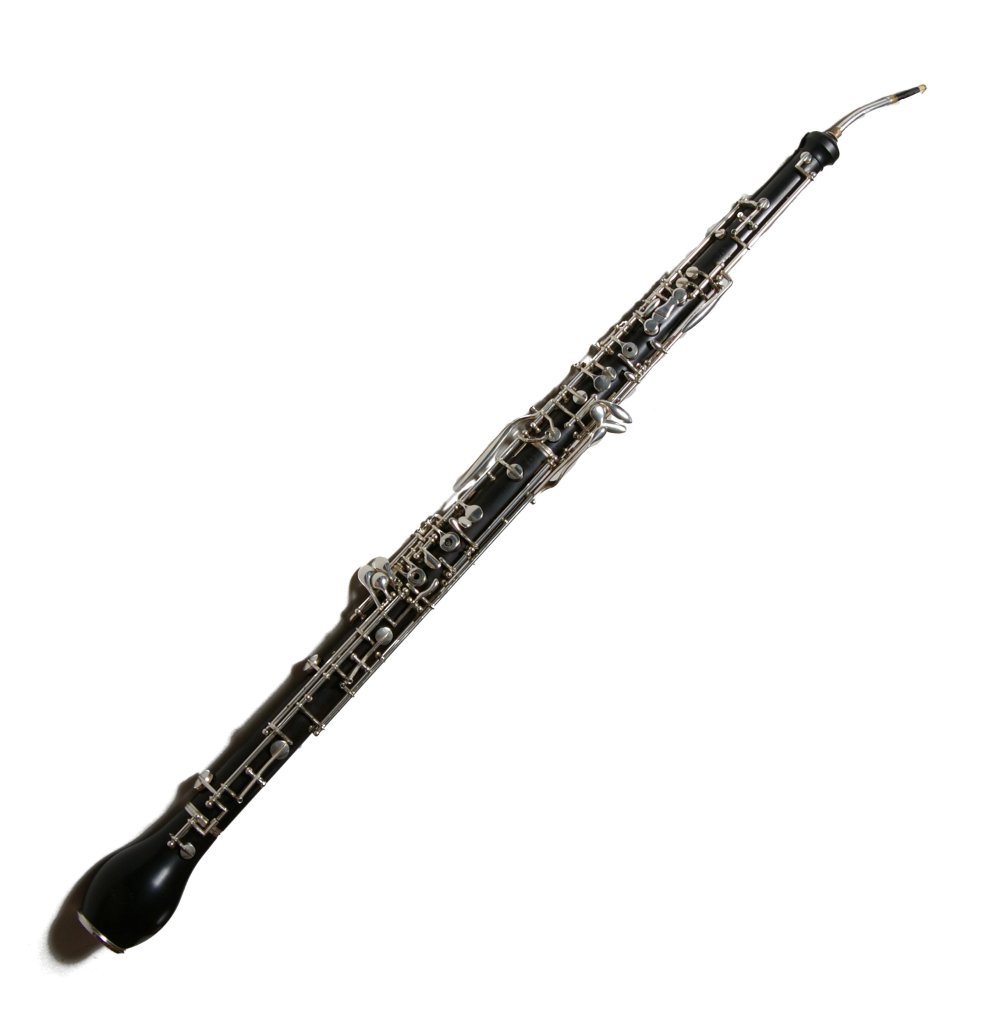
Since the length is 1.5 times that of Oboe, if you think about the relationship between frequency and wavelength, you can understand why there is a complete 5 degree difference in sound.
There is a curved pipe called Crook, and the name Cor Anglais comes from the meaning that this Crook has an angle (Anglais).
- Clarinet

Clarinet is an instrument created by combining the instruments Clarino and Chalumeau. Therefore, it contains the characteristics of both instruments, and the tones are specially distinguished according to these characteristics.
It has a wide range of sounds and a variety of techniques, so it is used a lot in modern music. The color is not too flashy, so it blends in well with the ensemble and has a good effect.
There are instruments in the key of Bb and key of A, and the A-key Clarinet has a heavier and more profound tone than the Bb. The written pitch below is based on Clarinet on Bb.

In Clarinet, the sound ranges are divided into five categories and given names. The characteristics are different accordingly.
1) Chalumeau: This is the lowest register of the Clarinet and has a profound and lyrical tone.
2) Throat tone: It has a thin and narrow tone as if a foreign substance is stuck in the throat, and is a very vulnerable sound range. Therefore, it is also a vocal range favored by modern music composers.
3) Break: This is the semitone section between Throat Tone and Clarino. It is difficult to trill quickly with a conventional Clarinet. So be careful when you need Trill. These days, there are cases where this has been improved.
4) Clarion, Clarino: This is a stable and melodic part. All playing techniques are possible, and even difficult and fast passages are possible.
5) High Range: The range above that is stable up to G, but if it goes up further, it can sound sharp and irritating. In soft sounds, it can sound similar to a flute. It is used a lot in modern music.
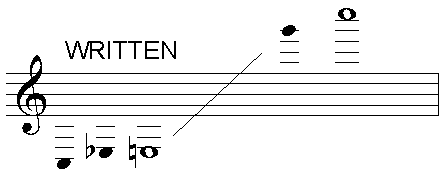
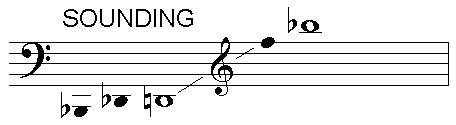
In addition, the most commonly used instrument among the Clarinet Family is the Bass Clarinet. The Bass Clarinet sounds one octave lower than the regular Clarinet, and is also a transposition instrument in the key of Bb. Like Flute and Piccolo, it is often used for doubling.
There are two types of transposition notation: the German method, which uses a major 2nd upward, and the French method, which uses a major 9th upward. Most of the time, the French method is used.
- Bassoon
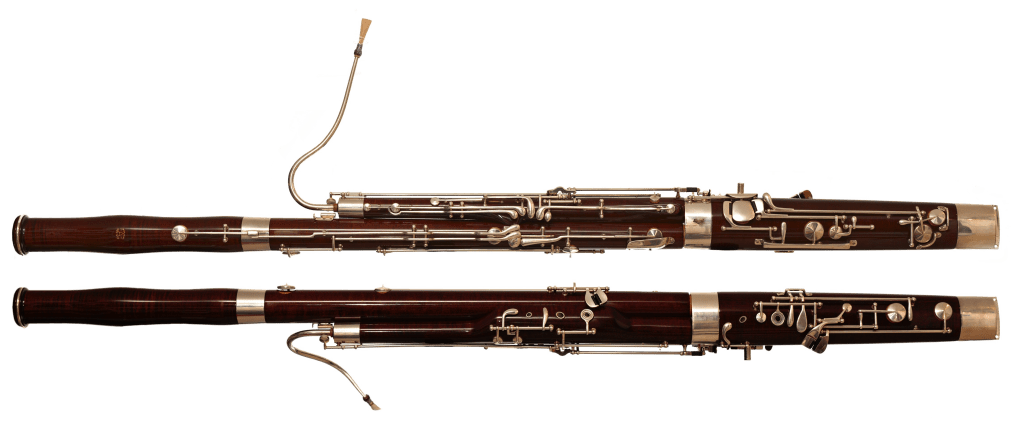
Bassoon is an instrument that plays the bass part of a woodwind instrument. Like Cello and Contrabass, Contrabassoon, which doubles in the low notes due to the sound tab, is also often used.
Compared to other instruments responsible for low sounds, the volume is not very loud, and assuming that all the wound tubes are stretched out, it is a very large instrument at 2.95 meters.
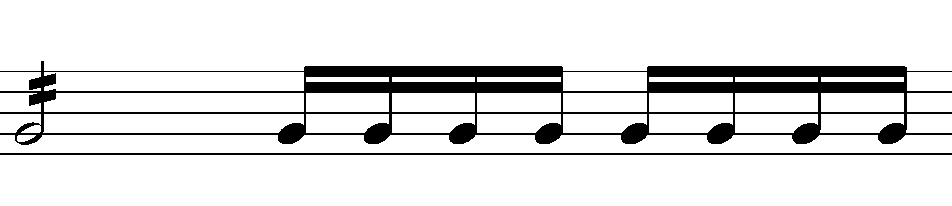
Also, like the Oboe, it is a double reed instrument, and is played with a reed attached to the end of a curved tube called a “crock”. Various playing techniques such as Staccato, Double, and Triple Touging are possible, and Tremolo is also effective, but Tremolo above 4 degrees is difficult. Like the Cello, the Tenor staff is also often used.
Because it is not a transposed instrument, the actual sound and notation are the same. It is difficult to produce a very soft sound like PPP, and the midrange works well. High registers don’t sound good, so the effect is somewhat reduced.
It is effective if you add the sound in the low range so that it is heard more clearly than the melody.
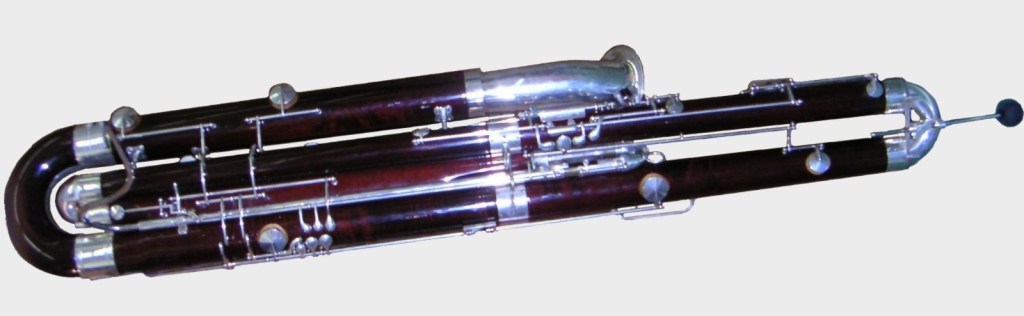
Contrabassoon, like Contrabass, focuses more on bass reinforcement. It is one octave lower than the Bassoon and can sound three degrees lower than the Contrabass.
Like the contrabass, it is a transposition instrument whose actual notes are played one octave lower than the notated notes. It has poor agility and quickness, and double and triple tonguing is difficult. Therefore, it is not suitable for strong drinks.
There is also an instrument called Subcontrabassoon, which is one octave lower than Contrabassoon.
- Woodwinds Organization
Unlike strings, woodwind instruments each have a unique sound, so when put into an orchestra, the number of instruments is very small compared to strings.
Even in full orchestras, there are usually two or three groups per woodwind instrument, and sometimes four groups. For a chamber size, 1 to 2 units are sufficient.
If it is an orchestra piece that includes woodwind instruments, it is usually a large orchestra, so panning can be done according to the normal orchestra composition. Since most virtual instruments in an orchestra composition are recorded at a fixed location, panning is often pre-configured, so you don’t have to think about panning.
In a woodwind quartet or quintet, it is common for instruments responsible for the low range, such as the Bassoon, Horn, and Oboe, to be placed in the middle.
The remaining instruments are used in various ways, including left and right.












 Jooyoung's Music Blog