
Hi! This is Jooyoung Kim, a mixing engineer and music producer.
During my undergraduate studies in physics, I often used my extra credits to take music courses. Looking back, I regret not taking any Python classes—especially now that I’m studying plugin development, data processing, and methodology. Without AI tools, I wouldn’t have been able to start coding at all.
Currently, I’m in the final semester of my master’s program in the Department of New Media Music. I’m not too worried about my thesis, so this semester, I’m focusing on a personal project: developing a saturation plugin in my own way. I know it will be challenging, but I also aim to write a paper introducing a new methodology for building audio plugins.
Now, let’s talk about oversampling and upsampling. This article is based on my book, ‘Basics of Mixing‘, released in South Korea.
What are oversampling and upsampling?
Many audio plugins offer oversampling, but what exactly is it, and how does it work?
- Oversampling: Increasing the existing sample rate by an integer multiple (e.g., ×2, ×4, ×8, etc.).
- Upsampling: Increasing the existing sample rate, but not necessarily by an integer multiple.
In oversampling, the process inserts zeros into the empty values and interpolates them using a low-pass FIR (Finite Impulse Response) filter..

Think of it like stretching an image by an integer factor: the blank spaces are filled in through interpolation. After processing the audio, the plugin then downsamples the result back to the original rate.
On the other hand, upsampling converts the sample rate to another rate through interpolation. This is a different process from oversampling.
Why do we use oversampling and upsampling?
Oversampling helps reduce aliasing and creates a more natural-sounding result, while upsampling is primarily used for changing the sample rate.
However, does an oversampling function always make a plugin sound better? That’s a different discussion.
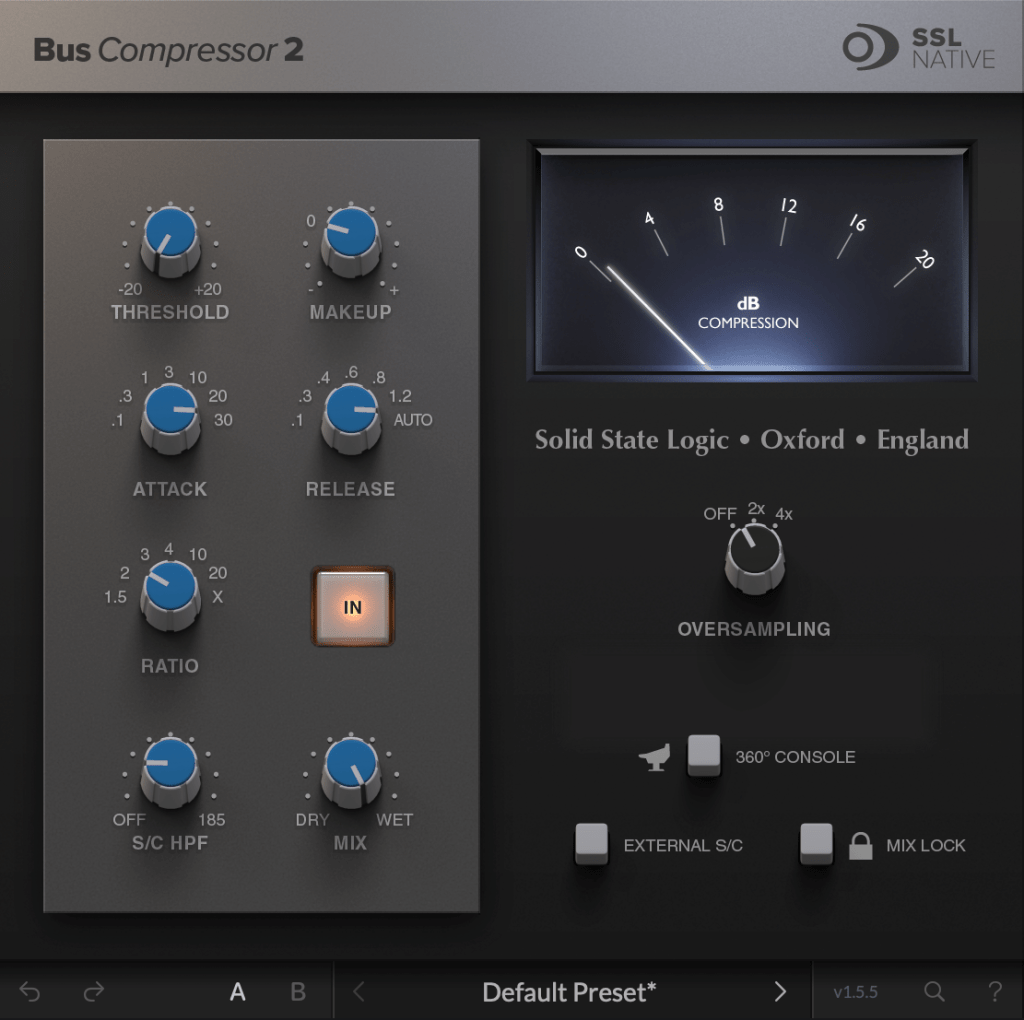
For example, the SSL Bus Compressor 2 plugin provides an oversampling option. Below, you can see the frequency response of the plugin:
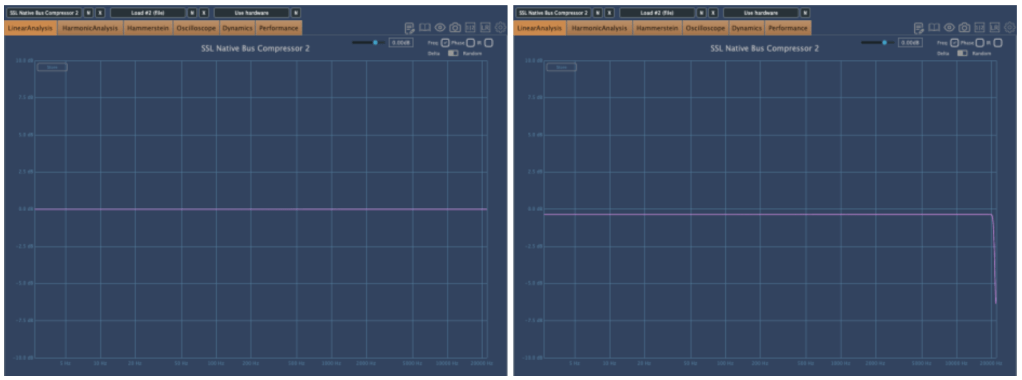
The left graph shows the response without oversampling. The right graph shows the response with 2× oversampling.
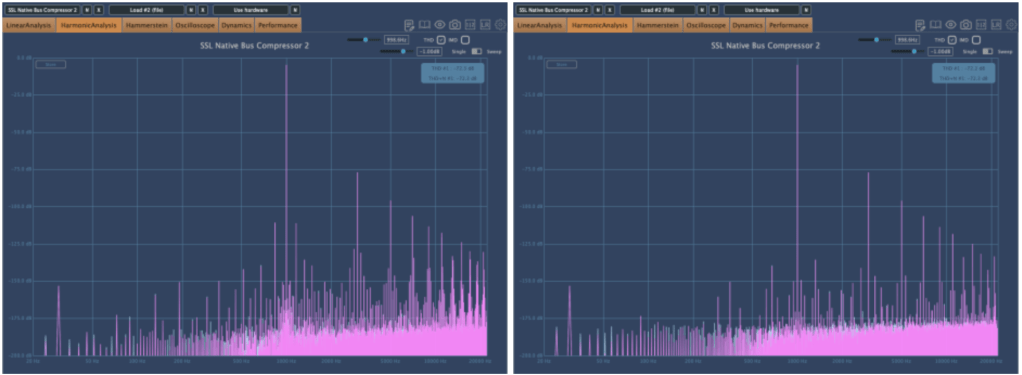
Both graphs exhibit harmonic distortion at the same positions. While other measurements appear similar, even small differences between the two can result in noticeable changes in sound. In my experience, non-oversampled processing often sounds better.
That was a brief explanation of oversampling and upsampling! See you in the next post!
 Jooyoung's Music Blog