Hello, I’m Jooyoung Kim, an engineer and music producer.
In my previous post, I mentioned that I had written a paper on subwoofers, right? On August 12, my paper, Group Delay-Driven Crossover Optimization for Subwoofer Satellite Systems at Listening Position, was officially published.
I had planned to write about it as soon as the paper was out, but time has been tight lately… ^^;;
This post is about how to set the crossover frequency for subwoofers.
The motivation behind this was pretty straightforward. Not only studios but also many individual users incorporate subwoofers into their setups. However, there’s surprisingly little guidance out there on how to properly set the crossover frequency.
From a perceptual perspective, there are papers suggesting that humans don’t easily perceive directionality below a certain frequency (say, a few Hz), so the crossover should be set below that threshold. But when it comes to numerical analysis, the only paper I could find was Dr. Bharitkar’s Automatic Crossover Frequency Selection for Multichannel Home-Theater Applications.
In that paper, the claim was that a flatter frequency response in the low-frequency range is ideal. However, dips in very narrow frequency bands often don’t show up clearly in numerical calculations of variance.
I was convinced there had to be a better approach. So last summer, I bought a measurement microphone and started taking measurements without a clear plan.
By experimenting with different crossover frequencies, I collected a ton of data and made an initial discovery: there’s a correlation between Group Delay (or Excess Group Delay) and the frequency response.
After trying various configurations, I found that Excess Group Delay wasn’t as strongly correlated, but peaks in the Group Delay (whether positive or negative) corresponded to dips in the frequency response. Moreover, the smaller the absolute value of the Group Delay, the less pronounced those dips became.
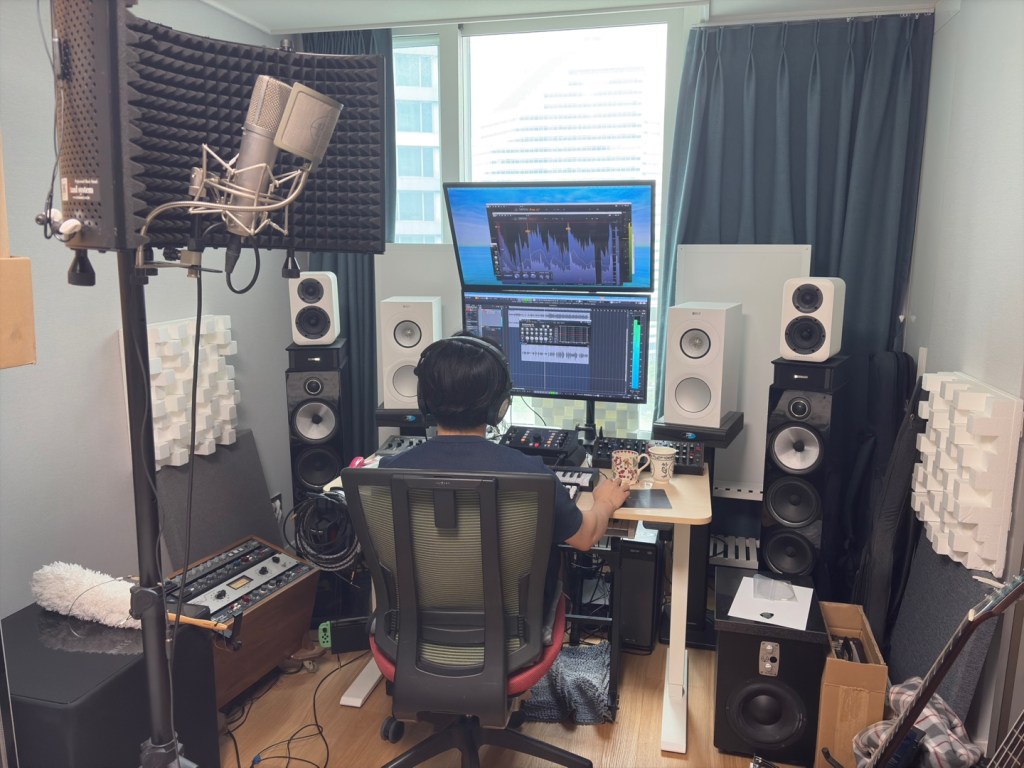
I conducted experiments in a university classroom and my own workspace, using a Finite Element (FE) model to demonstrate this correlation. My conclusion was that the crossover frequency should be chosen to minimize the maximum absolute value of the Group Delay in the low-frequency range.
Here’s the mathematical expression for it:

Looks a bit daunting, doesn’t it? ^^ Let me break down the terms:
- ω_oc: The optimal crossover frequency (frequency is typically denoted by ω).
- ω_LC: The lower bound of the crossover frequency (Low Crossover).
- ω_HC: The upper bound of the crossover frequency (High Crossover).
- GD(ω_i): The Group Delay value at frequency ω_i.
- α, β: Correction factors for the low-frequency range.
I included α and β because I noticed that Group Delay can vary significantly outside the adjustable crossover frequency range. These correction factors help account for that.
Setting the crossover frequency this way not only benefits phase response (since Group Delay is the rate of change of phase) but also improves the frequency response. (For those diving deeper: this is trivial in minimum-phase systems, but real-world systems aren’t always minimum-phase, which makes this approach meaningful.)
Additionally, I applied 4th-order Linkwitz-Riley filters to both the satellite speakers (the main speakers in a subwoofer-satellite system are often called “satellite speakers”) and the subwoofer, while carefully aligning timing and phase. These conditions are critical for the approach to work.
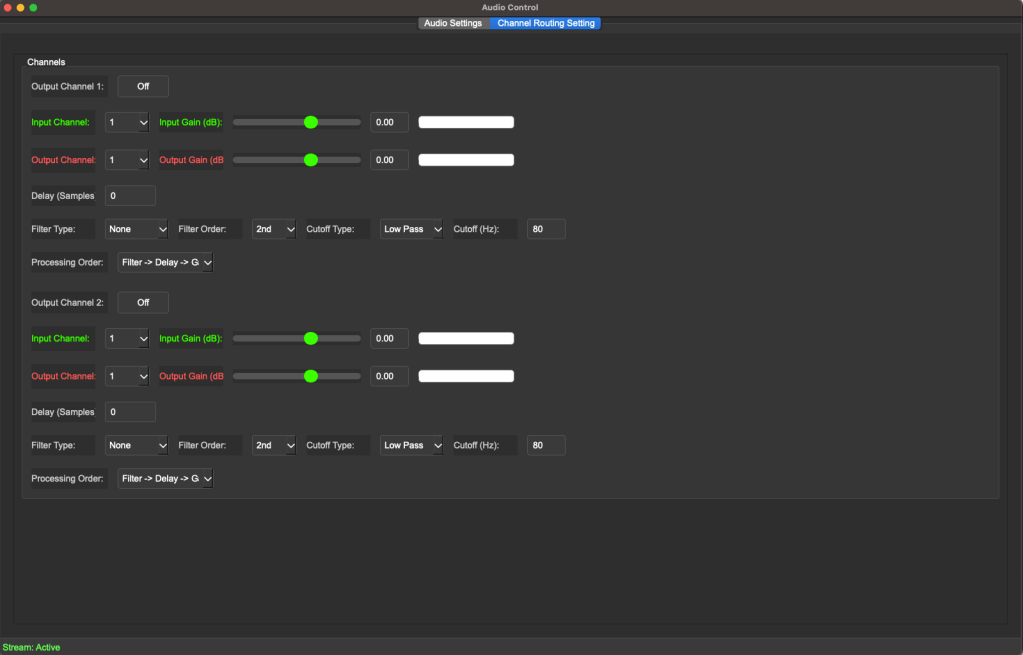
I was working on a tool to automatically measure and output audio based on this method, but analyzing the data to select the optimal crossover frequency turned out to be quite time-consuming. With other papers and projects piling up, I’ve had to put it on hold for now.
If I get some free time, I’d love to revisit it. It’d be amazing if a company like Genelec saw this and added it as a feature… haha. And if they wanted to sponsor me, that’d be even better… ^^;;
I tried to explain this in a straightforward way, but the topic itself isn’t exactly simple, so I hope I got the point across clearly! 😅
If you’re curious about the detailed setup or experimental process, feel free to check out the paper or reach out to me directly.
Until next time! 😊
 Jooyoung's Music Blog