Hello! This is Jooyoung Kim, a mixing engineer and music producer. Today, I’ll talk about the phase distortion synthesis method and synthesizers.
This post includes a few affiliate links. If you make a purchase through them, I may receive a small commission, which helps me keep writing…^^
In my last post, “Basics of Synthesizers (4) – Modulation Synthesis and FM,” I mentioned that Yamaha’s DX7 was called an FM synthesizer, but in reality, it uses phase modulation synthesis. Also, I already explained the phase modulation in short. Therefore, I will not discuss phase modulation further.
However, there is one more signal synthesis method, Phase Distortion (PD), invented by Casio, which uses the phase of the signal. Its principle is similar to that of Phase Modulation, which was invented by John Chowning.

The picture illustrates how the PD method works. First, you can see that the basic frequency counter resets to zero after a certain period – (a).
There is also another frequency counter with a slightly higher frequency than (a), which resets to zero when the (a) signal resets to zero – (b).
(b) signal is used the phase value of the sine signal – (c).
The inverted base signal (a), which is used as a windowing function that goes to zero at the end of the period -(d).
The final output signal obtained by multiplying (c) by (d). This multiplication levels out the sudden jump in (c), resulting in a smooth, filtered PD waveform – (e).
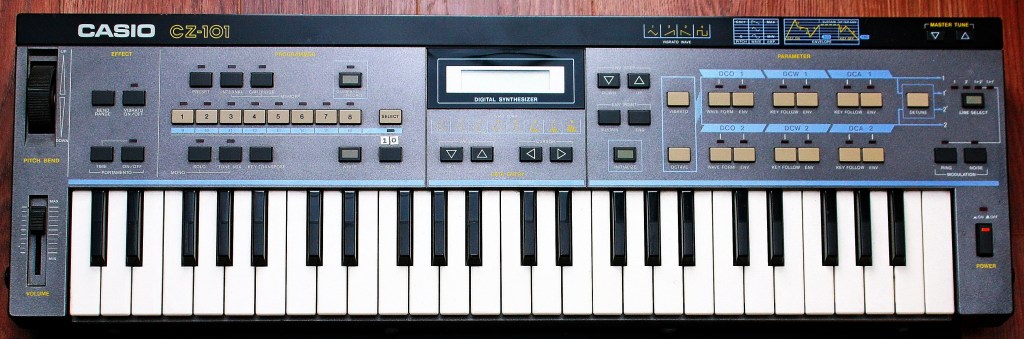
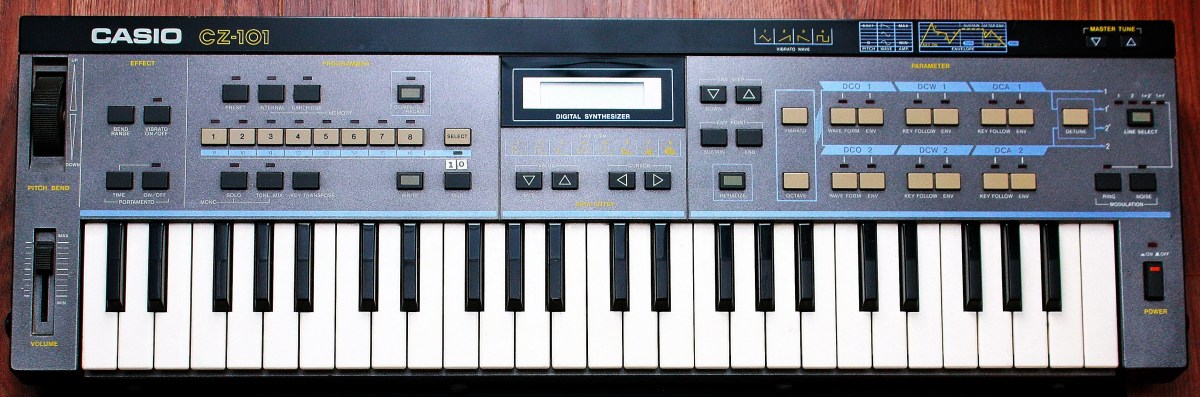
The Casio CZ series was the hardware synthesizer to which the PD method was applied.
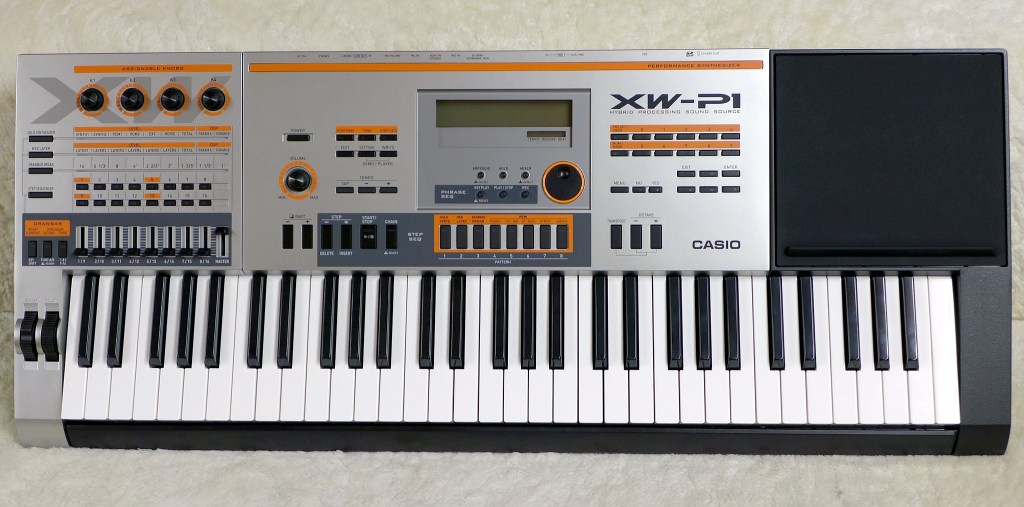
The Casio XW series also featured the PD method in its synthesis engine.
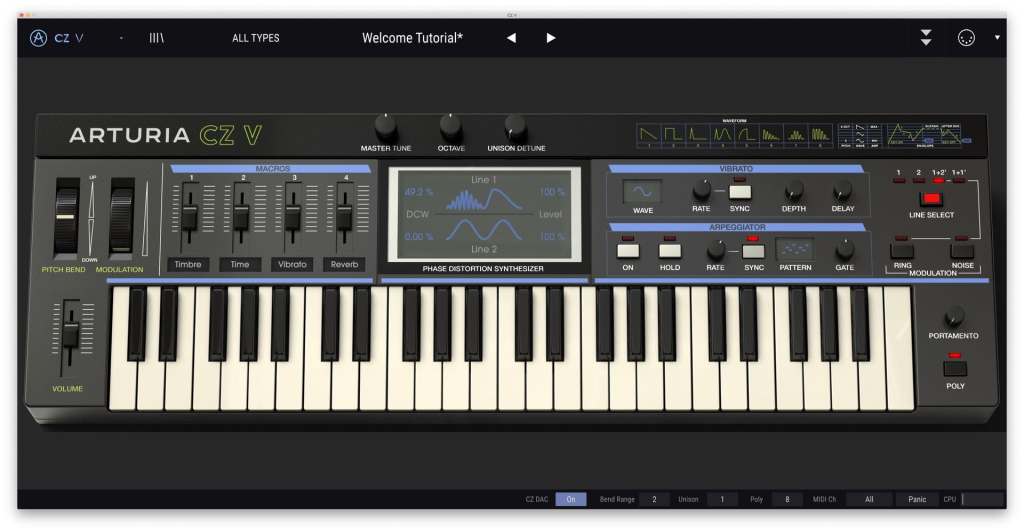
Phase Distortion (PD) method hardware synthesizers are not sold by other companies besides Casio. Therefore, if acquiring the real hardware is too expensive or inconvenient, using software emulations like Arturia’s CZ-V is a handy alternative.
That’s all for today. See you in the next post!
 Jooyoung's Music Blog


.jpg)