Arturia FX Collection 2 Plug-In Review (Part 2, EQ Sitral -295)

※This article is a review written on July 21, 2021 after being selected for the FX Collection 2 experience group run by ‘Samick’ and receiving product support for a certain period of time. I only received support for the product and wrote the rest myself.

EQ Sitral-295

The Sitral-295 plug-in is a clone plug-in of the Siemens Sitral W295 EQ.
Siemens Sitral W295 EQ is an EQ module included in the Sitral console produced by Siemens, and was produced in West Germany in the 60s and 70s.

Siemens is the parent company of the former Telefunken company and is now a multinational conglomerate, so it would be a good idea to take a look if you are interested in the history of equipment.

​This Sitral-295 plug-in consists of a total of 3 modules and is composed of Discrete Class A. Surfing the web, I heard that you can think of German-style Pultec or Neve. There is also a story behind the fact that many of Neve’s devices originated from the Sitral console’s schematics.

Some say that it seems that Rupert Neve copied the Sitral console’s U273 limiter circuit diagram and created the Neve 2254.

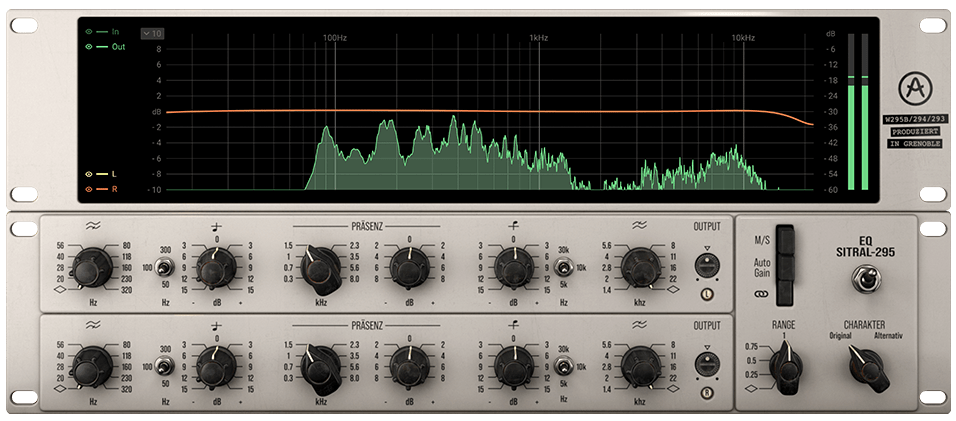
The Signal Flow of the Sitral-295 plugin is as shown in the photo above.

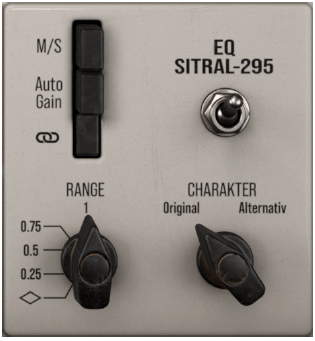
Excluding the three switches, Range, Charakter (German), and Auto Gain, you can think of it as simply moving from the left to the right of the plug-in. Each function will be explained in the description of the module below.

  • Visualizer

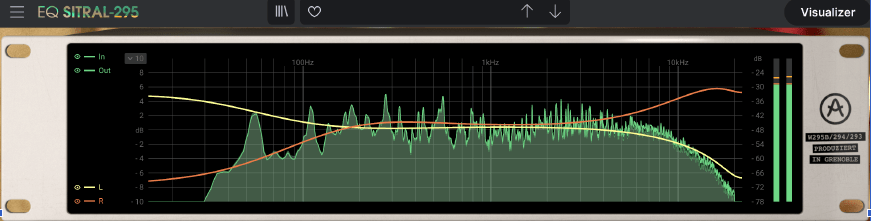
A Visualizer is literally just an analyzer. It shows the EQ curve adjusted by LR or MS, and shows the audio frequency currently being played.

Analog device clone EQ plug-ins often do not have this function, so it is a bit inconvenient when using them for the first time, but Arturia seems to have done a good job keeping this convenience in mind.

  • Saturation
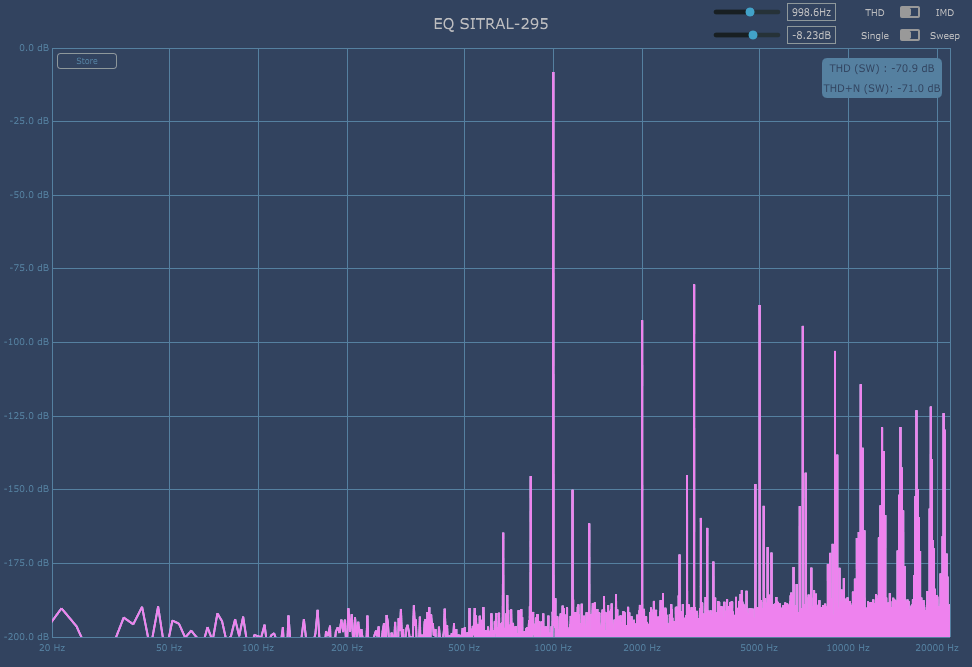
Harmonic Distortion of Original Charakter
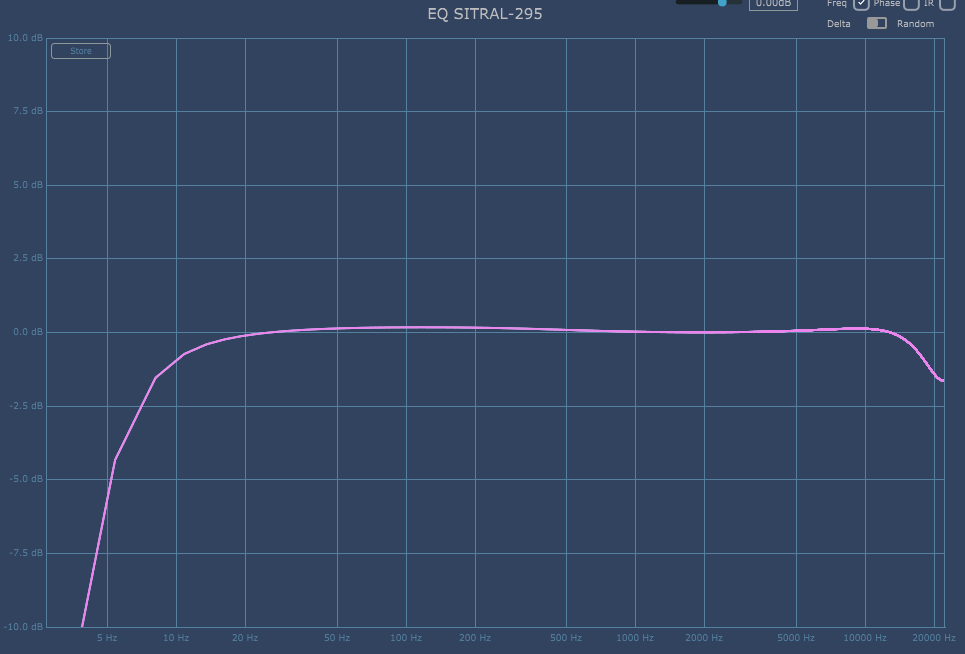
Frequency Response of Original Charakter

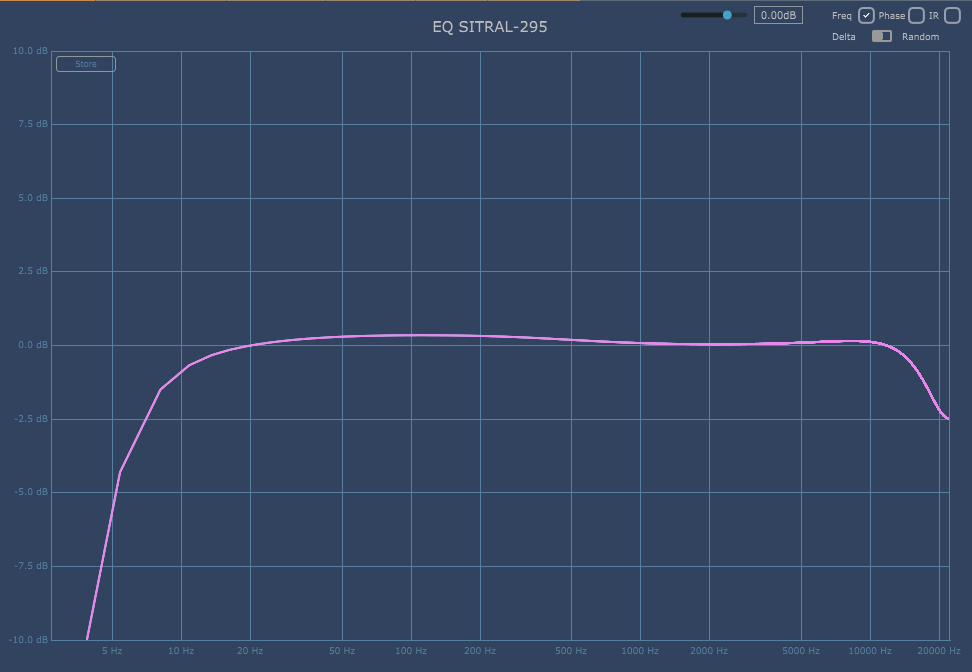
Sitral-295 is an EQ that adds saturation by default even if you select nothing. Even with all EQ and filters turned off, high cut is applied from about 14kHz and low cut is applied from 10 to 20Hz.
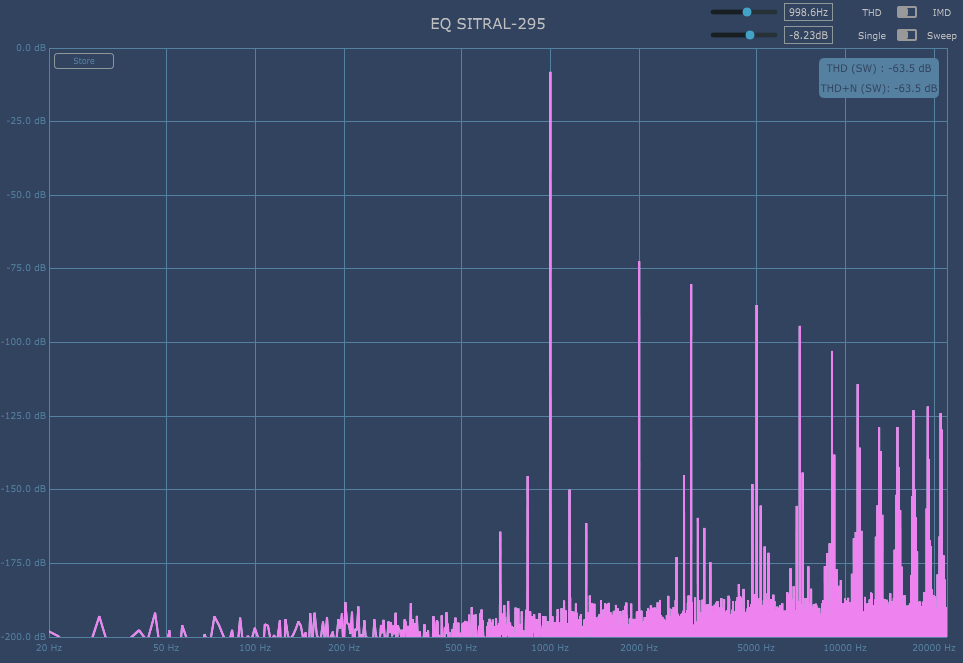
Harmonic Distortion of Alternativ Charakter
Frequency Response of Alternativ Charakter

If you change the Charakter from Original to Alternativ, the nuance of the cut will change slightly, and the second overtone will rise slightly.

  • Module 1, 2

Out of a total of 3 modules, 2 modules have the same configuration and are responsible for Left and Right respectively. These two modules consist of Filters on both sides and three EQs in the center.

The slope of the filter is not separately written, but I measured it with Plugin Doctor and it seems to be around 8~9dB/Oct. Actually, these types of double EQs are used for a saturation feeling rather than a surgical feeling, so the slope value doesn’t seem to be particularly important, but it would have been better if it had been written down..^^

For the remaining EQs, the Q value cannot be adjusted, and the low range can be adjusted to a fixed dB of 50, 100, and 300Hz, the midrange to 300~8000Hz, and the high range to a fixed dB of 5, 10, and 30kHz.

When I used it myself, it felt brighter in the mid-range than the UAD Neve 1073, and the mid-low range was somewhat similar to that of the UAD Pultec, but the mid-high range felt very different. I think you can just think of it as a new Saturation EQ.

​When I just turn it on in the sibilance band by default, it sticks out with a sharp feeling that I don’t like, so it’s a bit burdensome, but I think it’ll be fine if you just organize that band well. Or, I don’t think it would be a bad idea to just set it as default to friends who lack the 3~5kHz band.

  • Module 3

The third module has switches. M/S is a button that changes to Mid/Side, Auto Gain is a button that makes the amount of input gain and output gain the same, and the chain shape below is a link button that links L, R or M, S.

You can think of Range as similar to the Mix knob. At diamond shape, EQ and Filter are not applied at all, and at 1, they are applied at 100%. 0.5 applies only to 50%.

As mentioned above, Charakter is a switch that slightly changes the basic Frequency Response and Harmonic Distortion.

  • EQ Sitral-295 overall review

I think the Saturation EQ leaves something to be desired in the mid to high range. Of course, you can adjust it, but in fact, it is quite annoying to adjust it..^^;;

Still, Sitral-295 definitely has character, so I think I’ll use it someday.

I created a sample track in the order of the original track – Arturia EQ Sitral-295 – UAD Neve 1073 – UAD EQP-1A, so if you are curious, you can give it a listen.

Arturia FX Collection 2 Plug-In Review (Part 1, Bus Force)

※This article is a review written on July 21, 2021 after being selected for the FX Collection 2 experience group run by ‘Samick’ and receiving product support for a certain period of time. I only received support for the product and wrote the rest myself.

Before starting

Hello? This is engineer and singer-songwriter Jooyoung Kim!

This time, I was selected as a member of the experience group for Arturia FX Collection 2 conducted by Samick and wrote a review.
Although my skills and knowledge are still lacking, I would appreciate it if you could be lenient.

So shall we begin?

The reason I applied to the Arturia FX Collection 2 experience group

Was it around the beginning of this year?.. Music Tribe, the parent company of Behringer, and companies such as Sweetwater and Thomann formed a direct partnership, making it possible to purchase Music Tribe products at a much cheaper price than before.

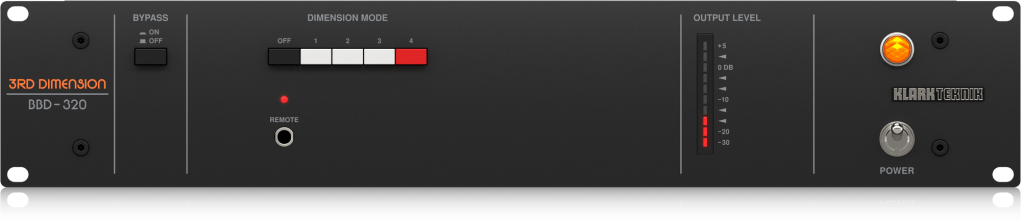
I was also curious about reprinted products, so I was looking around and came across a reprint of the Roland Dimension-D SDD-320, which Klark Teknik has been selling since around October of last year.

Above all, the price was about $150, and even including the shipping cost, it was only $200, so I thought a lot about whether or not to buy it because I thought there would be no tariffs. However, it was too risky to buy it blindly, so I looked up some reviews.

https://gearspace.com/board/gear-shoot-outs-sound-file-comparisons-audio-tests/1323683-roland-dimension-d-comparison.html

Fortunately, Gearslutz, now Gearspace, has conducted tests on all Dimension-D clones.

There were a lot of different things, including reprinted hardware, but surprisingly, the one I liked the most was Arturia’s Dimension-D.
So, I decided to put aside the hardware clone and buy a plug-in later.
Time passed like that, summer came, and I heard that Arturia had released the FX2.

As well as Roland’s Dimension-D, there was a Neve 33609 clone, an STA clone, and a bunch of other good-looking plugins. I was quite interested in it because I knew that the quality of the plug-ins bundled with Arturia’s audio interfaces was not bad.

However, it was sold for $149 as a launch discount, but I was not able to purchase it because I had already bought a lot of plugins due to other companies’ summer sales.

Meanwhile, I saw a post on a community ‘Cuonet'(Korean music community) that was recruiting FX Collection 2 experience groups, so I applied for the experience group.

Features of FX Collection 2

The existing FX Collection is

3 Filters: MINI, M12, SEM
3 preamps: 1973, TridA, V76
3 Reverbs: Plate-140, Intensity, Spring-636
3 Delays: Tape-201, Memory-Brigade, Eternity
3 Comps: VCA-65, Tube-STA, FET-76

It consisted of a total of 15 plugins.

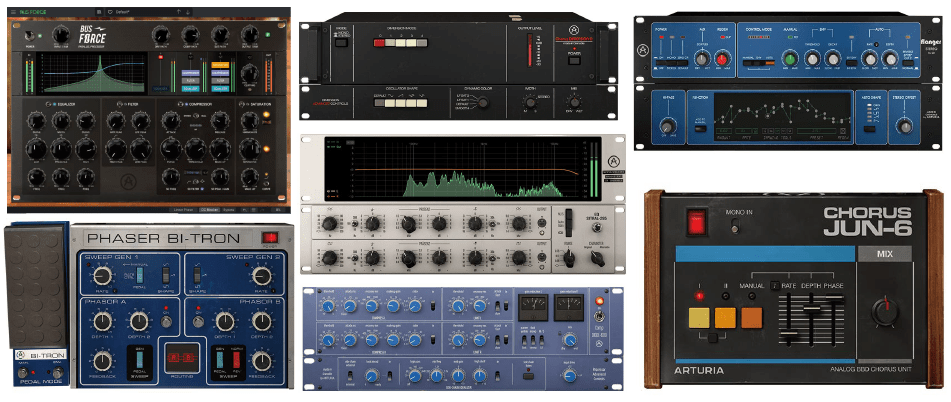
4 Modulations: Dimension-D, Jun-6, BI-Tron, BL-20
3 Mix Buses: Force, Diode-609, Sitral-295

With these 7 plugins added, it consists of 22 plugins.

Introduction to newly added plugins

The seven plug-ins added this time are all clones of existing hardware.
(BUS Force is slightly different. It is based on hardware, but it can be said to be a unique plug -in of Arturia)

Personally, I will take a closer look at Diode-609 and Dimension-D, which I personally find most interesting among the newly added plug-ins, and briefly look at the rest of the plug-ins along with their plug-in descriptions.
(I think it would take too much time to organize the remaining plugins..^^;;)

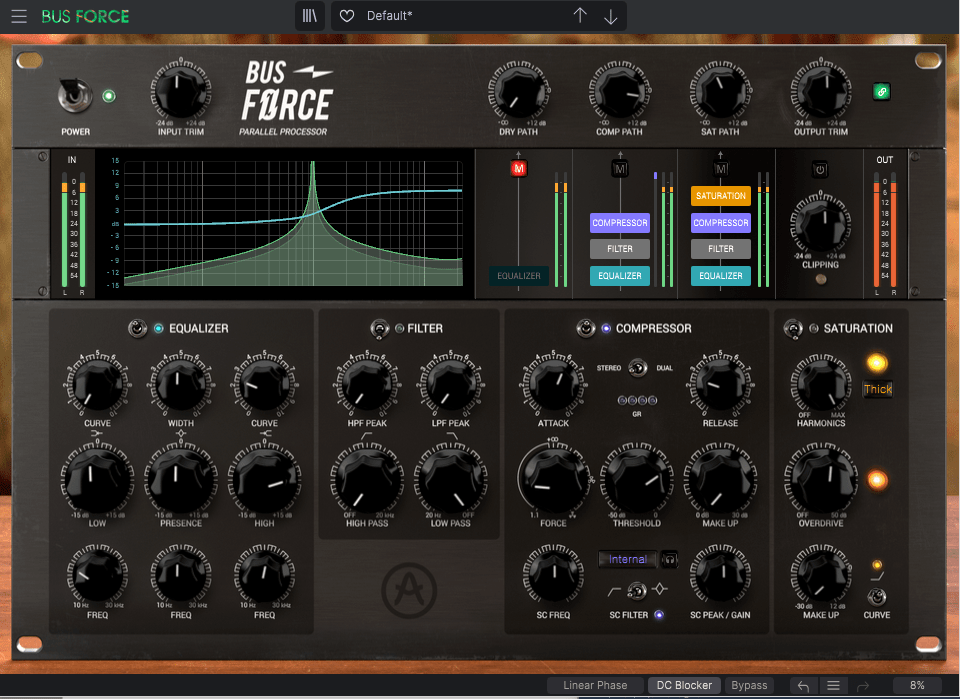
Bus Force

Bus Force is a plug-in designed to be attached to a bus stage like a typical Channel Strip plug-in.
They didn’t say exactly which one was cloned, but judging from the nuances in the manual and website description, it seems like the EQ was a clone of Pultec EQ and the filter was a clone of SEM’s Filter.

The compressor is only listed as a VCA type, but since it can even achieve negative compression, I think it is a combination of compressors such as dbx160, SSL G Comp, and API 2500 (I’m not sure about this). Saturation also seems to have various functions by combining several devices.

Signal Path is designed to solve all problems with one plugin.

The signal entering Bus Force is divided into three in the plug-in and subjected to parallel processing.
The first signal only takes EQ, the second signal takes Eq, Filter, and Compressor, and the third signal takes Eq, Filter, Compressor, and Saturation.

​Each signal can be muted or its gain can be adjusted, and effects on each path can be removed. And finally, after the three signals are combined, they go through clipping and are sent to the final output stage.

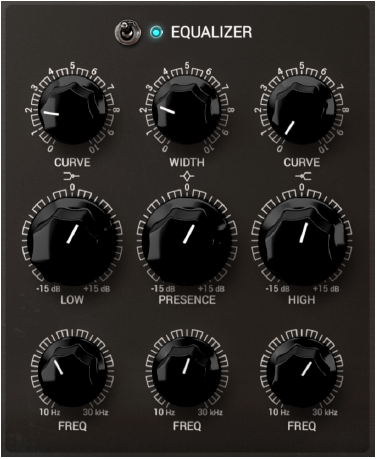
  • EQ

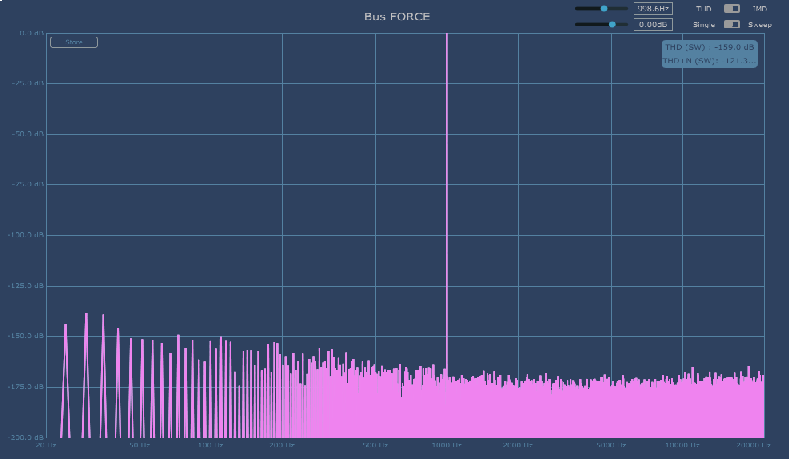
This EQ is said to be a reprint of Pultec. After experimenting with some samples myself and checking with Plugin Doctor, I was a little disappointed that Harmonic Distortion (Saturation) was not included.
(There is Saturation in the 3rd signal path, so I think you should use that)

However, I liked that the Q value and frequency value could be adjusted more flexibly than other Pultec EQ clones, and it seemed to create a smooth EQ effect well.

This is the frequency response that appears when only EQ is added. As you can see, no overtones are visible. Noise is the default noise and is at a level of -150dB.

The manual says that if you want to preserve the feeling of air, try adjusting the Hi Frequency Curve to about 4.5.
In fact, if you adjust it like that, the air feel of the sound will come out a lot.

  • Filter
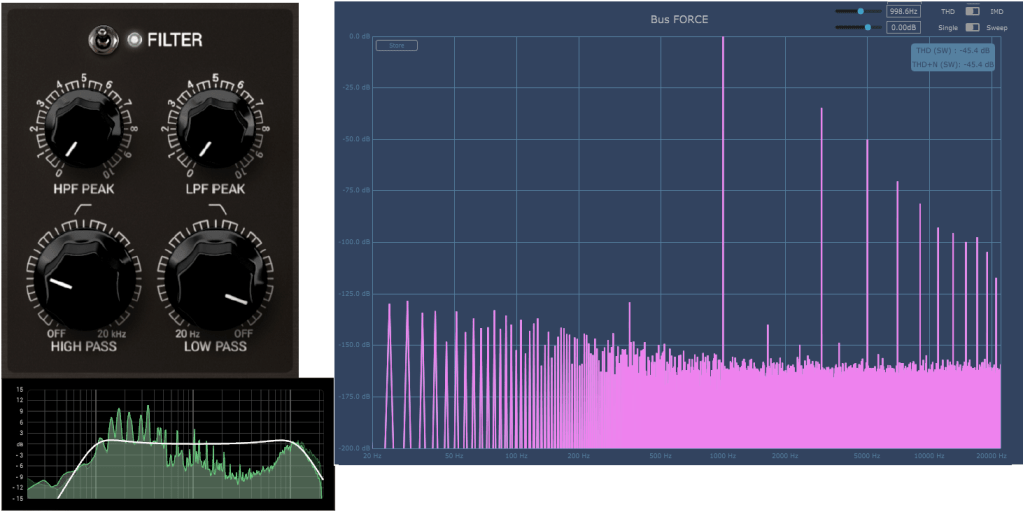
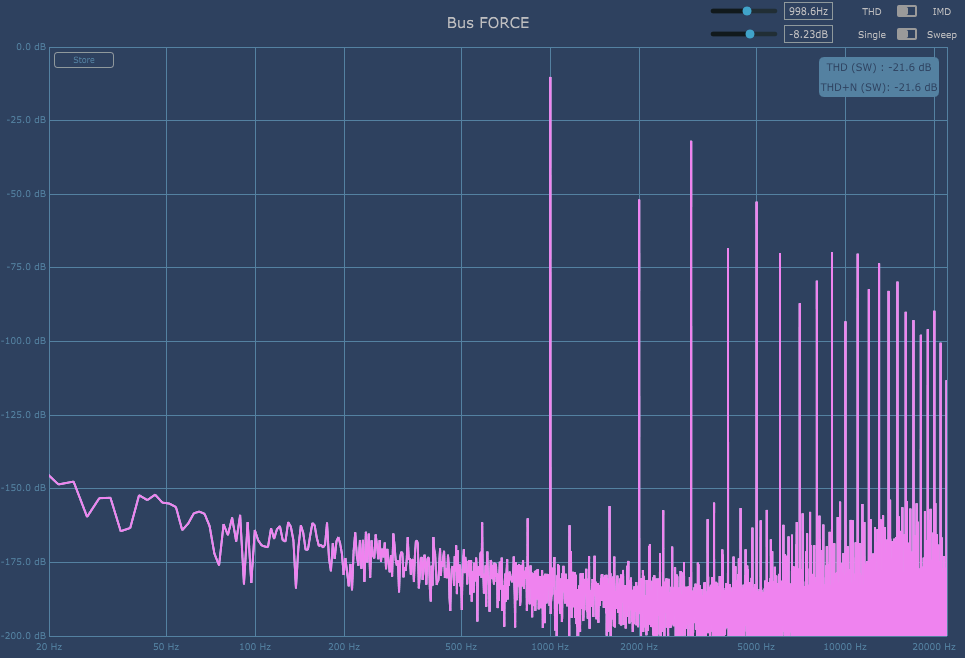
It is convenient to be able to view the parameters being adjusted and the frequency response on the plug-in’s analyzer. Also, as you can see from the frequency response graph, odd-numbered harmonic distortion is usually present.

I don’t know much about filters in synthesizers, so I can’t say whether the clone was good or bad.

However, since it can create peaks, it seems to be convenient to use when organizing the bass, and it also seems to be useful for smoothing out the high frequency part.

The slope of each filter is 12dB/oct, which is commonly used in filters. Also, when the Filter is activated, Harmonic Distortion is added and Saturation is added.

  • Compressor

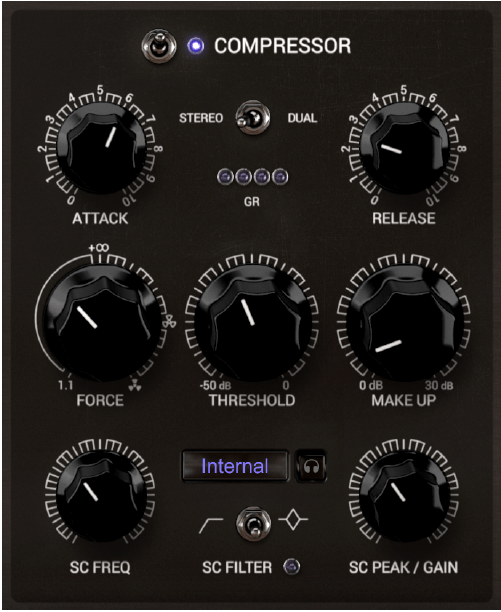
This VCA type compressor can receive internal sidechain and external sidechain signals and compress them. As a compressor attached to the bus, I was surprised that it expressed the feeling of glue better than I expected.

In particular, it was nice to be able to provide a frequency of up to 2000Hz when using the internal sidechain. This may be useful when giving signals using hi-hats or high-frequency percussion.

However, one thing that is disappointing is the GR lamp. One light comes on every time 8dB is attenuated, but in fact, it is not common to apply that much compression at the bus stage… Of course, you can apply strong compression and mix it in a parallel way…^^;;

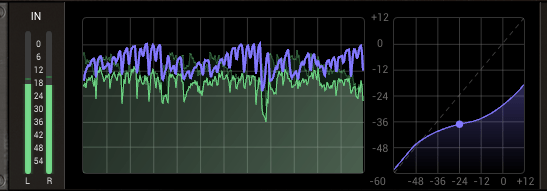
It is a clean type compressor that does not produce much harmonic distortion. When adjusting the Compressor, the analyzer is displayed like this.

Ratio (Force) can range from 1:1 to minus, Attack can be adjusted from 1 to 300ms, and Release can be adjusted from 1 to 500ms. I think it would have been a little better if there had been an Auto Release like SSL G Comp or Neve33609.

Still, it was a compressor that seemed to be useful when you wanted clean compression.

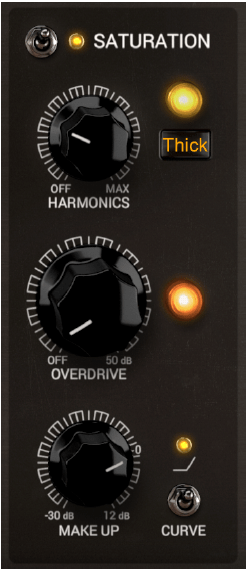
  • Saturation
The feeling of all three saturations is different. Even with Overdrive, it changes again. Also, Harmonic Distortion is all strong.

Saturation was very interesting. You can choose from three saturations: Thick, Odd, and Even, and the saturation is quite strong.

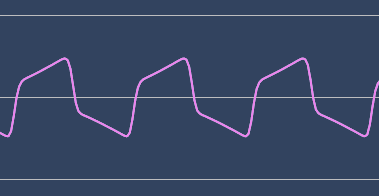
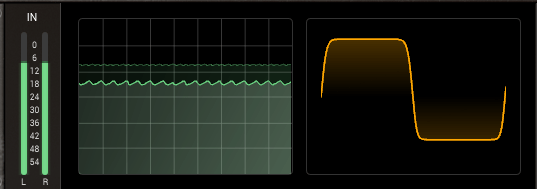
In particular, the saturation is quite strong in Thick. Even the slightest touch to Overdrive will result in significant saturation. The larger the value of both parameters, the more the waveform is affected.

  • Clipping

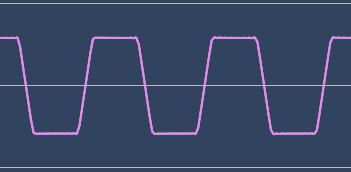
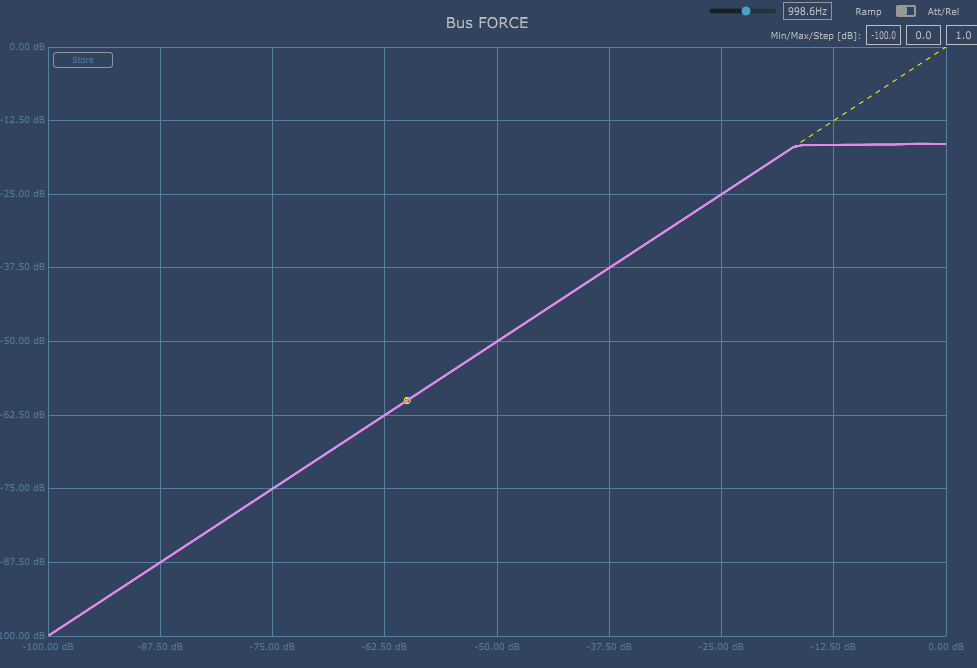
Clipping is literally a clipper. I expected it to be soft clipping, but it was just a very strong limiter.

The waveform is distorted into a square like a typical distortion pedal, and the compression is cut very cleanly. Harmonic Distortion also comes up. It was a bit disappointing that it wasn’t soft clipping.

  • Bus Force overall review

There are one or two things that are disappointing, but I think the Compressor alone would be useful. However, the biggest drawback of this plugin is that it consumes a lot of CPU.

Even though I only used 3 inserts, it took more than 1/4 of the space… (The CPU was using an Intel 8th generation i7-8700)

I think it would be a bit difficult to use it multiple times other than literally attaching one or two to the final stage, such as the Bus stage or Master stage.

I really liked the Compressor.