Hello! This is Jooyoung Kim, an audio engineer and music producer.
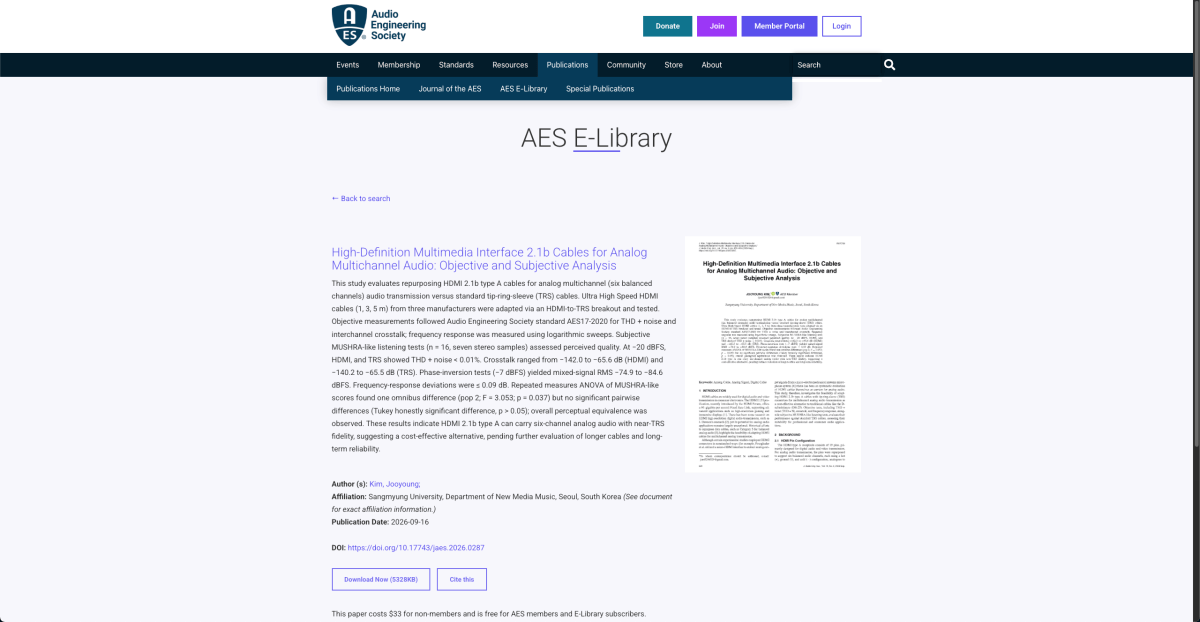
Last week, my recent research was published in the Journal of the Audio Engineering Society, which is regarded as one of the best research journals in this field.
The title of the paper is “High-Definition Multimedia Interface 2.1b Cables for Analog Multichannel Audio: Objective and Subjective Analysis.”
When I started this research, I wondered if it was feasible to publish in the prestigious journals I wanted to target. It stemmed from a surprisingly simple idea – ‘People use LAN cables for analog audio these days, but why don’t they use HDMI cables instead? With the emergence of Wi-Fi and wireless internet transmission systems, HDMI cables have become much more common nowadays.’ – making it quite unexpected that such a simple concept would end up in a top-tier journal.
Therefore, I wired an HDMI female connector to a TRS connector… 🙂
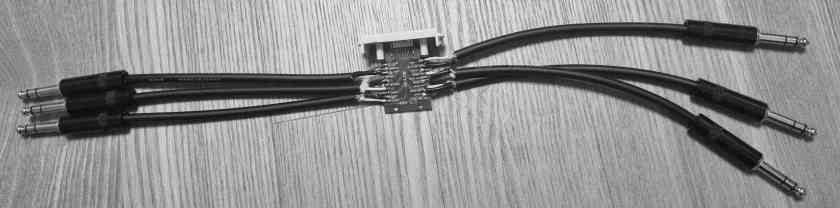
Something like this weird creation, featuring one HDMI cable for every six TRS connectors!
So, following this, I wrote a Python program to measure THD+N and crosstalk in compliance with the AES17-2020 standard, as well as the frequency response. (Note: Measuring the frequency response is not related to this standard.)
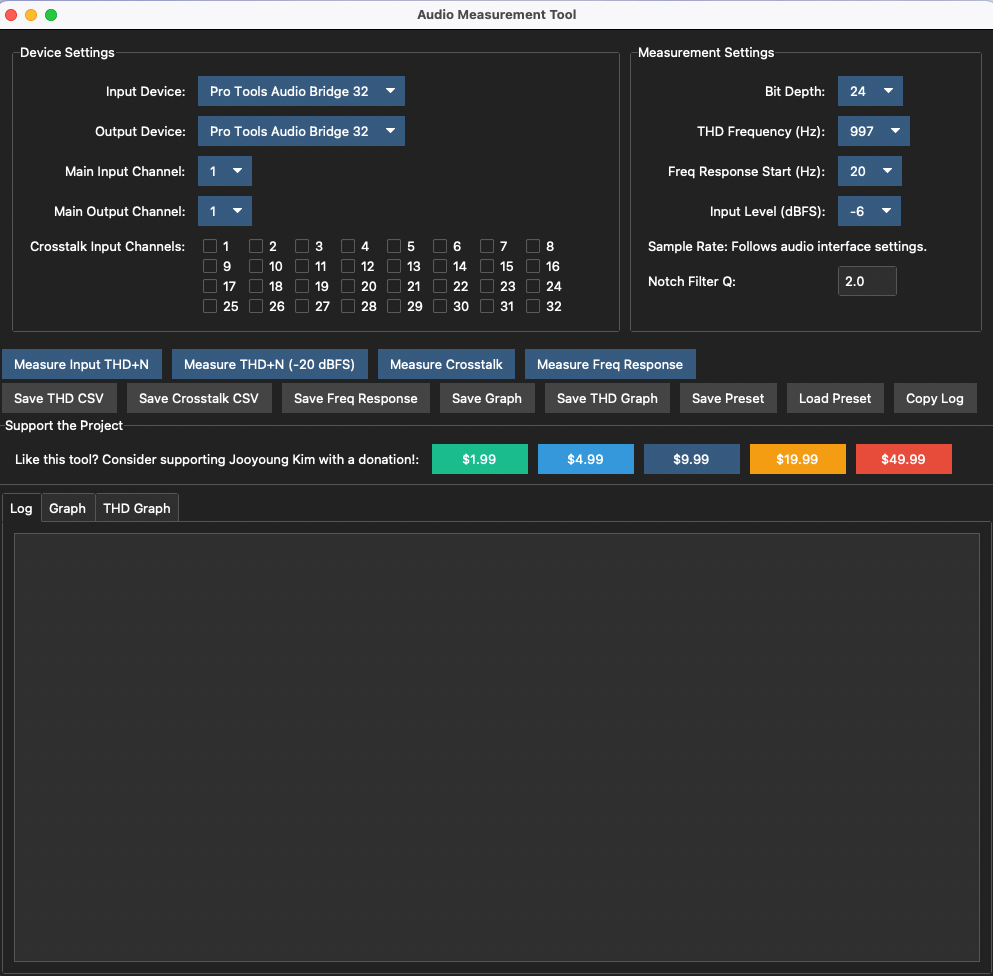
You can check out the program via this Github link (https://github.com/JYKlabs/Audio-Measurement-Tools).
I ran the main audio tests using the program I shared on GitHub, which included comparing pure TRS cables. Separately, I used a quick, simple Python script I wrote to perform a phase-cancellation test, and I also conducted a listening test using the MUSHRA standard via webMUSHRA.
I tested nine different HDMI 2.1b cables across three different brands, covering 1-meter, 3-meter, and 5-meter lengths for each (3 lengths × 3 brands = 9 cables). As a reference, the comparison cable was a Canare L-2T2S, and the TRS connectors were Rean NYS228BG.
The result was simple! In the listening test, people couldn’t tell the difference between the cables, and the objective measurements also showed that using HDMI 2.1b cables for analog audio works surprisingly well.
You can read the full paper via this link: https://doi.org/10.17743/jaes.2026.0287.
Additionally, all supplementary materials can be found here: https://zenodo.org/records/19621854.
The paper exceeded the page limit by two pages, so I had to pay an extra $200. Honestly, I paid it gladly just to be published in such a great journal—I’m really excited!
However, I cannot share the full paper here due to the journal’s copyright policy – sorry about that!
Also, another piece of research related to a Korean traditional instrument was accepted by the Journal of the Acoustical Society of Korea last Monday! I’ll share more about the subject once it’s officially released.
That’s for all today. See you in the next post!

