My Research Paper Was Published in the Audio Engineering Society (Which Relates to HDMI Cables for Analog Audio)

Hello! This is Jooyoung Kim, an audio engineer and music producer.

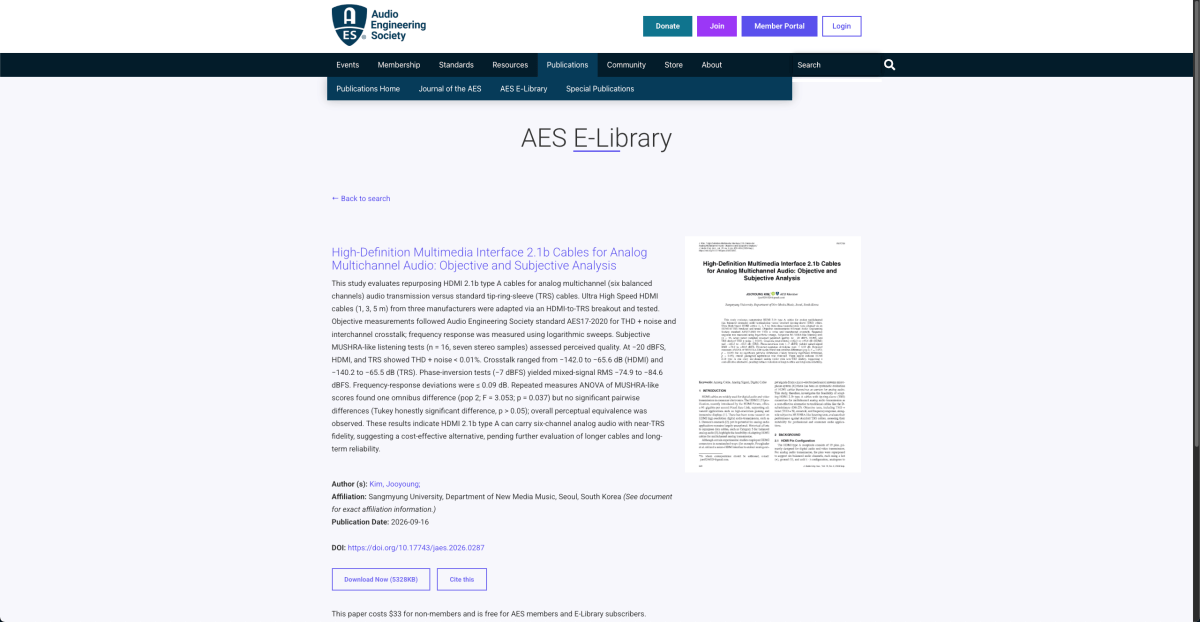
Last week, my recent research was published in the Journal of the Audio Engineering Society, which is regarded as one of the best research journals in this field.

The title of the paper is “High-Definition Multimedia Interface 2.1b Cables for Analog Multichannel Audio: Objective and Subjective Analysis.”

When I started this research, I wondered if it was feasible to publish in the prestigious journals I wanted to target. It stemmed from a surprisingly simple idea – ‘People use LAN cables for analog audio these days, but why don’t they use HDMI cables instead? With the emergence of Wi-Fi and wireless internet transmission systems, HDMI cables have become much more common nowadays.’ – making it quite unexpected that such a simple concept would end up in a top-tier journal.

Therefore, I wired an HDMI female connector to a TRS connector… 🙂
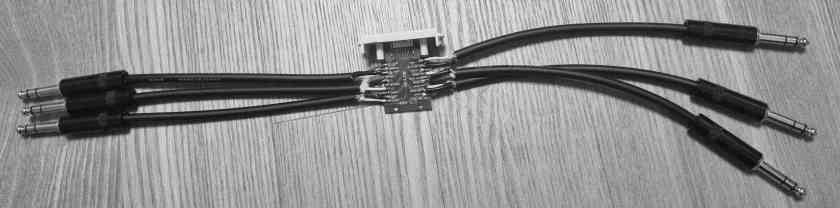
Something like this weird creation, featuring one HDMI cable for every six TRS connectors!

So, following this, I wrote a Python program to measure THD+N and crosstalk in compliance with the AES17-2020 standard, as well as the frequency response. (Note: Measuring the frequency response is not related to this standard.)
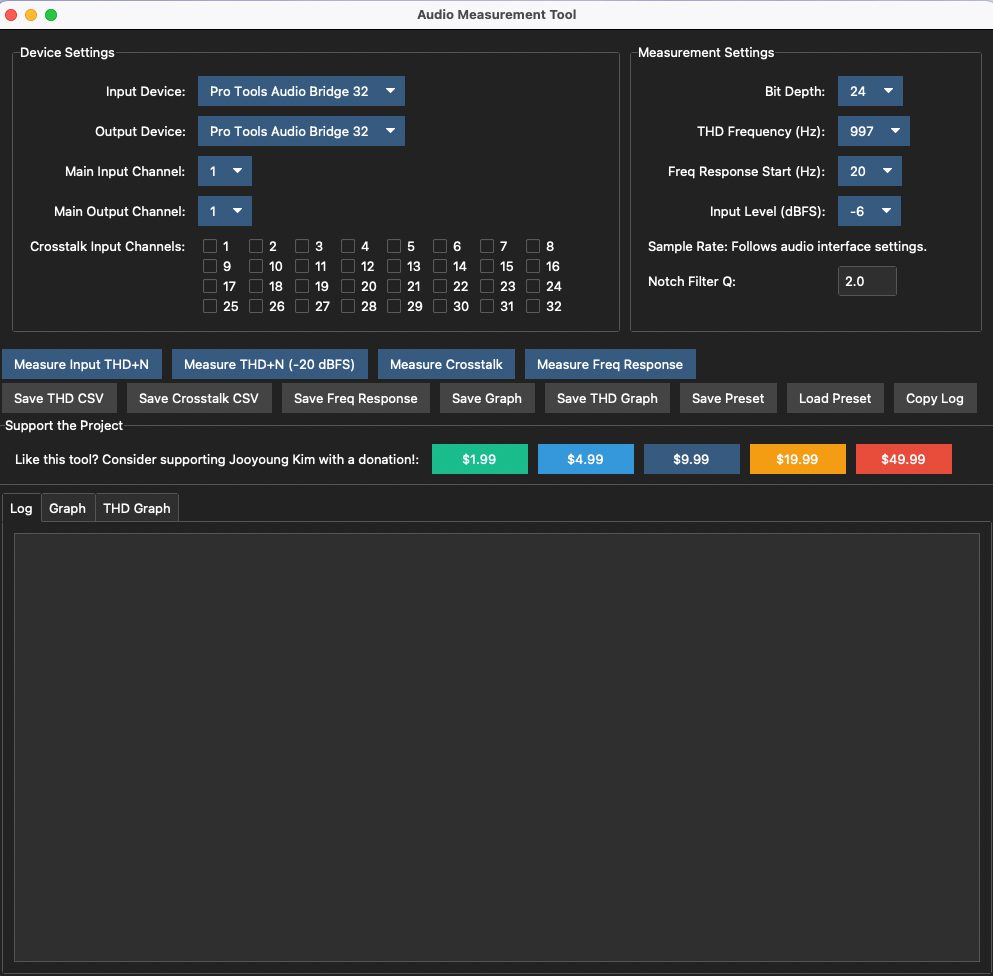
You can check out the program via this Github link (https://github.com/JYKlabs/Audio-Measurement-Tools).

I ran the main audio tests using the program I shared on GitHub, which included comparing pure TRS cables. Separately, I used a quick, simple Python script I wrote to perform a phase-cancellation test, and I also conducted a listening test using the MUSHRA standard via webMUSHRA.

I tested nine different HDMI 2.1b cables across three different brands, covering 1-meter, 3-meter, and 5-meter lengths for each (3 lengths × 3 brands = 9 cables). As a reference, the comparison cable was a Canare L-2T2S, and the TRS connectors were Rean NYS228BG.

The result was simple! In the listening test, people couldn’t tell the difference between the cables, and the objective measurements also showed that using HDMI 2.1b cables for analog audio works surprisingly well.

You can read the full paper via this link: https://doi.org/10.17743/jaes.2026.0287.

Additionally, all supplementary materials can be found here: https://zenodo.org/records/19621854.

The paper exceeded the page limit by two pages, so I had to pay an extra $200. Honestly, I paid it gladly just to be published in such a great journal—I’m really excited!

However, I cannot share the full paper here due to the journal’s copyright policy – sorry about that!

Also, another piece of research related to a Korean traditional instrument was accepted by the Journal of the Acoustical Society of Korea last Monday! I’ll share more about the subject once it’s officially released.

That’s for all today. See you in the next post!

Basics of Mixing – 2.5 Volume and Signal Level

Hello! I’m Jooyoung Kim, a mixing engineer and music producer.

Today, let’s talk about volume and signal levels.

If you’re interested in sound, you’ve likely heard the term “Equal Loudness Contour.”

This term refers to the fact that our ears perceive different frequencies at different volumes. The curves that connect sounds perceived as being of equal loudness are known as equal loudness contours.

Looking at the graph, you can see that humans tend to hear less of the low and ultra-high frequencies and more of the high frequencies at the same volume level.

(*Recently, the standard for Equal Loudness Contour was revised from ISO 226:2003 to ISO 226:2023.)

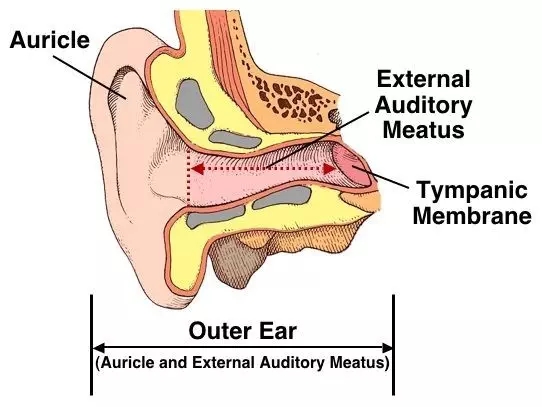
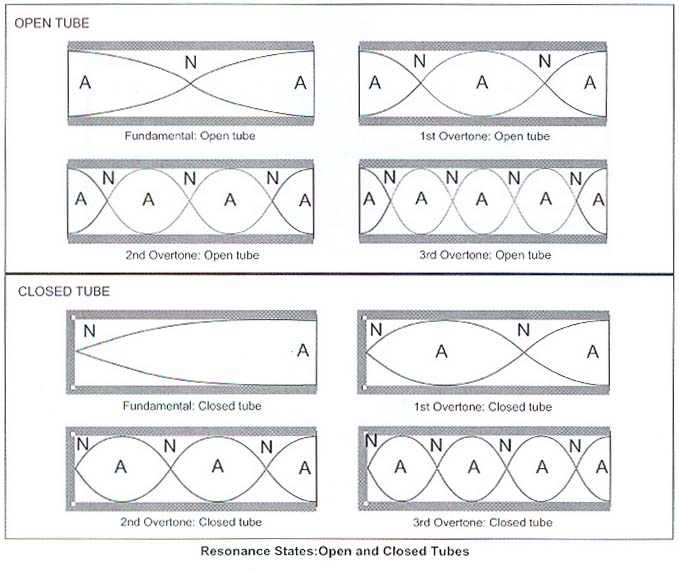
This phenomenon occurs because our ears are shaped like a closed tube.

A closed tube resonates at wavelengths that are at least one-fourth the length of the tube. The external auditory meatus (ear canal) is typically about 2.5 cm long, so it can resonate with sound waves that are around 10 cm in wavelength.

Since the speed of sound is typically calculated at 340 m/s, we can determine that the resonant frequency is approximately 1700 Hz. Additionally, the resonances in the ossicles make the high frequencies more audible.

Why is this important to know?

The equal loudness contours show that as volume increases, the lows and highs sound more balanced. This is why music mixed at high sound pressure levels (SPL) can sound tinny or weak when played at lower volumes.

So, what is an appropriate volume level for mixing? Generally, 80 dB SPL is used as a standard. Famous mastering engineer Bob Katz recommends using 83 dB SPL.

(Here, dB SPL refers to the decibel unit used to express sound levels, such as airplane noise or inter-floor noise.)

I found a video from Presonus that discusses how to set speaker volume. For those who work in home studios, 80 dB SPL might sound quite loud. Personally, I work around 75-70 dB SPL as 80 dB can be painful for my ears. Just make sure you’re not working with the volume too low.

Now, let’s move on to basic signal levels.

In audio, there are four main types of levels:

1) Microphone Level / Instrument Level

  • These signals are very weak and need to be boosted to line level using a microphone preamp or DI box.

2) Line Level

  • This is the level at which audio equipment typically communicates. It’s used in audio interfaces, mixers, hardware EQs, compressors, and other devices.

3) Speaker Level

  • To play the signal through speakers, it needs to be amplified to speaker level. This requires a power amplifier. Active speakers have built-in power amplifiers, whereas passive speakers need an external power amplifier.

4) Mixing Level

  • The levels dealt with during mixing are almost all line levels.

Line level is usually divided into two categories: Pro Line Level and Consumer Line Level. Pro Line Level is based on +4 dBu, while Consumer Line Level is based on -10 dBV.

  • dBu is a unit based on 0.775 Vrms.
  • dBV is a unit based on 1 Vrms.

(Brief Explanation of RMS : Since electrical signals are AC, simply averaging them would yield a value of zero. Therefore, the root mean square (RMS) is used to find the average.)

When converting between these units, nominal level and peak level differ. Pro levels are higher, and consumer equipment typically has lower headroom, which can cause compatibility issues with pro equipment.

However, modern high-fidelity equipment often has high signal levels, so it’s becoming less of a concern.

That’s about all you need to know about signal levels.

With this foundational knowledge, we’ve covered the basics needed for mixing. In the next article, we’ll look at DAW functions in detail.

See you in the next post!