Noise(소음) Single

Hello! I’m Jooyoung Kim, a mixing engineer and music producer. In this post, I’ll be sharing the process behind my single album released in 2021. Although the timeline might feel a bit off since I wrote this a while ago, I hope you enjoy reading about the journey.

The inspiration for the song began near a construction site close to my home.

From the year before last to last year, there was continuous construction right next to my house, which was extremely noisy. Towards the end of the construction, they seemed to be in a hurry, working even in the early mornings and sometimes on weekends, which was incredibly stressful. At the same time, I was dealing with some personal family issues that made things even more suffocating.

So, I pre-wrote the lyrics to express my desire to escape this situation. I started composing the song more concretely from February this year.

I wanted the lyrics to be fairly simple but impactful, so I aimed to incorporate rock elements. I also thought using unconventional industrial percussion could effectively convey the feeling of noise.

Thus, I used a snare drum with significant reverb and a strong attack, along with various metal percussion sounds and tubular bells used in orchestras.

When I reopened the project file, I noticed I had used over 100 tracks for the mix (with 46 tracks for the instruments).

For the vocals, I used a Peluso P87 microphone, and for the guitar, a Peluso CEMC6. Both were recorded through the HA-73EQ.

Additionally, I recorded the guitars using different Nashville tunings for the left and right channels.

Apart from the percussion, I paid special attention to the strings. I arranged the parts separately using sheet music and included them through BBCSO.

Looking at some of the sheet music, you can see there are quite a few notes.. ^^;;

Orchestrating these instruments took as long as mixing them. Once I get more familiar with it, I’ll be able to work faster, but for now, I put a lot of intent into each part.

Another critical part I focused on was the beginning and end guitar sections. I tried to enhance the groove and rhythm through bass movement, and I hope it came across as intended.

In terms of mixing, the EMT250 I purchased at the time played a significant role. Its broad and expansive reverb matched the song perfectly.

I got the R2 at a very reasonable price, yet its natural reverb exceeded its cost. So, I used it for the overall hall reverb.

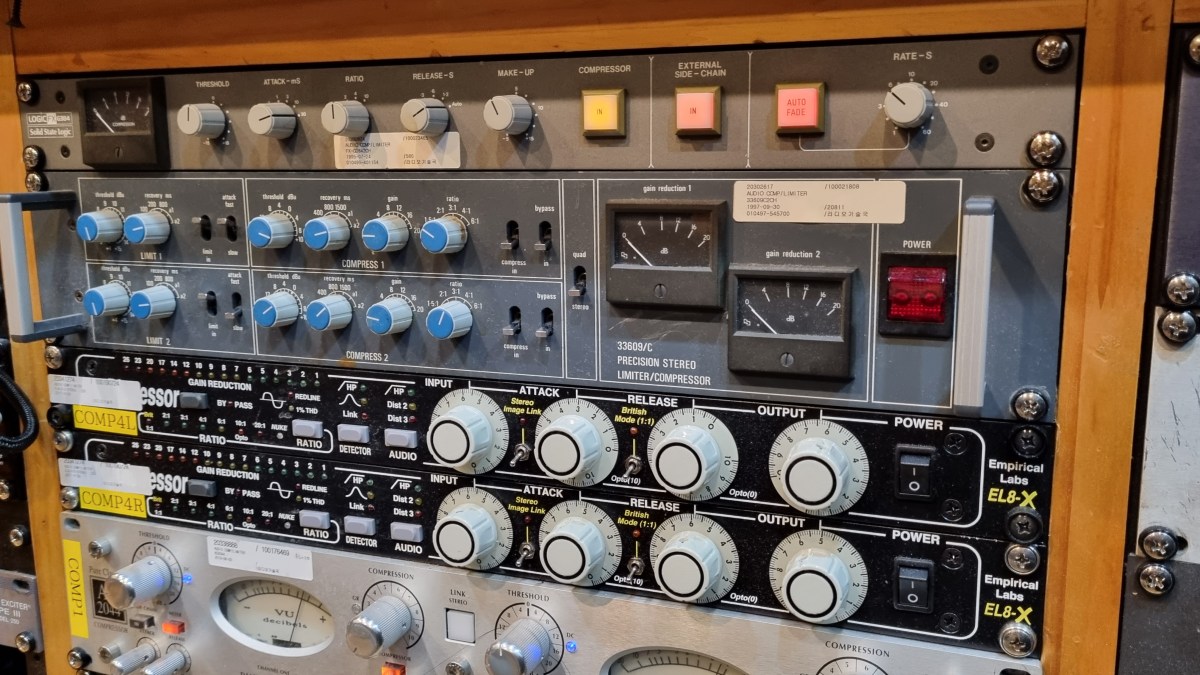
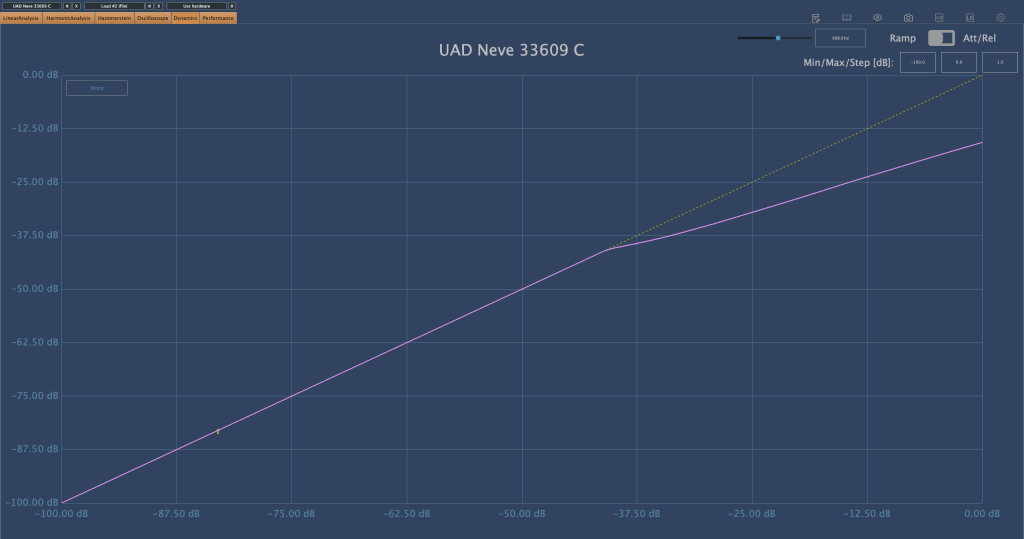
Explaining every detail of the mix would take too long.. Another unique aspect of this mix was adding parallel saturation and heavy compression at the final mix stage to make the sound a bit noisier.

Other than that, there wasn’t any notable processing. The pitch and rhythm tuning, along with the volume automation, took the most time. Aligning the string tracks with the timing and articulation was a painstaking process, revisited countless times.

Thus, after completing all the composing, arranging, recording, and mixing, I sent the track to a mastering studio.

I’m always curious about how different places produce sound, and I wanted to visit the studio to check the sound directly if possible. So, I booked a session at 821 Sound Studio but had to conduct it online due to COVID-19.

On the mastering day, the engineer sent me the files, and I was immediately impressed by how well the sound was captured, so I gave my approval right away.

I had been focusing on the higher frequencies and missed some details in the lower range, but the engineer brought out the groove in the low end perfectly, which was very satisfying.

(The engineer provided two versions: one with more aggressive processing and another balanced version. The aggressive one brought out the groove I intended.)

My track is listed in the discography on the lower left side of the 821 Sound website.

Examining the waveform later, I was surprised by how dynamic it remained despite looking heavily compressed. It reaffirmed the importance of mastering engineers.

I had to wait for about three weeks for the appointment and felt bad about not being able to visit the studio. The engineer kindly invited me to visit once the COVID-19 situation improved, and I promised to do so when possible.

I also worked on the music video simultaneously. I collaborated with PD Kilsangmun, who operates as a one-man team.

We had a Zoom meeting before the shoot to discuss the direction, color, and feel of the music video.

I wanted to shoot in a setting similar to the backgrounds in Rain’s “Gang” music video and Henry’s loop station scenes from JTBC’s “Begin Again.” I also wanted the color tones similar to Kim Dong-ryul’s “Lonely Voyage” and Replay by Wonder K.

The PD had a different interpretation of “noise,” viewing it as the overwhelming information in the world and wanting to depict an escape from it.

After exchanging ideas, the PD sent a plot. Unlike my previous music videos, the PD handled the entire story this time.

The initial plan was to film people overwhelmed by information like noise in a 3D effect, but we decided to go with a more traditional music video approach if that proved too challenging.

We chose an abandoned factory in Pohang for its low cost and nearby sea for additional shooting locations.

A few days before the shoot, I realized we hadn’t discussed costumes. Since I didn’t have the budget to buy new outfits, I used my own clothes.

The PD wanted a work uniform or khaki pants look, but I mostly had semi-formal or denim styles. So, we decided on a white t-shirt and blue jeans, with the PD providing an additional shirt.

We scheduled the shoot for Sunday, July 18th. As the PD works solo, he drove us to the location (I felt bad since I have a dormant license..).

We started early at 5 AM and arrived at the beach in Pohang around 10 AM. We began with the beach scenes as it would be difficult to shoot after sunset.

The sky seemed ready for rain, and the forecast predicted rain in the afternoon.

We shot the beach scenes, including multiple takes of running scenes from various angles. The PD ran alongside me, both of us sweating but with some relief from the breeze.

After about two hours of shooting until noon, we debated whether to eat. Both of us tend to feel unwell if we eat on important days, so we skipped lunch as well.

Instead, we had some snacks and rested at a cafe before heading to the abandoned factory.

The factory was dusty, with lots of dust kicked up during drone shots.. ^^;;

Eventually, my clothes were soaked, and shooting became difficult. I had a spare white t-shirt, so I switched between the two.

Despite the physical toll, it felt liberating once everything was done. As we hadn’t eaten all day, I offered to treat the PD to anything he wanted on the way back. However, most places at the rest stop were closed except for a few restaurants.

Feeling sorry, I promised to buy him a drink once the music video was out, but COVID-19 has made meeting up difficult.

We also took photos for the album cover at the factory. Ironically, the first photo we took turned out to be the best, which I edited for the album cover.

The PD drove us back, and we returned around midnight.

Two weeks later, on July 27th, the editing was complete. We decided to go with the second option without the 3D effects as the PD found it challenging.

This time, it seemed more niche, and it didn’t get featured prominently elsewhere, but thankfully Bugs featured it on their main page.

That’s the end of this song’s production diary. I couldn’t write in great detail as time has faded some memories, but I hope you found it interesting! 🙂

I’ll see you in the next post~!

Basics of Mixing – 4.1 Volume Balance

Hello! I’m Jooyoung Kim, an engineer and music producer.

In my previous post, we discussed organizing tracks. Today, we’ll delve into volume.

  • Why Volume is Crucial

Volume is the beginning and end of mixing. Higher volumes bring elements closer to the listener, while lower volumes push them further away. This simple principle helps place instruments within the stereo image created by your speakers.

  • How to Set Volume

First, listen to some reference tracks. Songwriters often get so absorbed in their own work that they miss when certain instruments are too loud or too quiet. Reset your ears by listening to professionally mixed songs.

Next, return to your DAW and mute all the tracks. Unmute a key track, such as the kick, snare, or vocal, and set its volume appropriately. Use this as a reference to balance the volumes of the other tracks.

While adjusting volumes, align the phase of multi-track recordings like drums and start some basic panning of instruments.

(Note: For more on phase alignment, refer to my previous post: 2.2 Phase and Interference. Details on panning will be covered in a future post.)

Once you move into more detailed processing, you’ll use volume automation, but this initial balance setup is crucial.

Avoiding Digital Clipping

One key point is to avoid digital clipping. If signals in your DAW are too high, the DAC can’t process them, resulting in distorted sound. This is digital clipping, and it prevents proper mixing.

Clipping occurs when the meter exceeds 0dBFS. Some DAWs can handle signals beyond this without clipping, but if your bit depth isn’t in a float format, clipping can happen when you export, causing damage.

Ensure your final master doesn’t exceed the 0dBFS peak meter mark to avoid clipping.

That’s it for today. Keep these tips in mind, and I’ll see you in the next post!

Takamine D5D NAT Guitar Review

Hello! I’m Jooyoung Kim, a mixing engineer and music producer.

The D series is Takamine’s entry-level lineup, structured as D-series, G-series, and Pro-series.The D-series is numbered from 1 to 5, with models 1 to 3 featuring laminated tops and models 4 and 5 having solid spruce tops. The D4 comes with a mahogany back and sides, while the D5 features rosewood back and sides.Let’s dive into the details!

  • Appearance

The packaging is slightly different this time, prominently displaying the D-series label.

This model has bridge pins. The nut, saddle, and pins are all plastic.

The guitar comes strung with discontinued D’Addario EXP strings. It seems that while individual packs are sold out, bulk packs are still available.

The neck has a matte finish, and the binding is a slightly yellowish plastic.

As an entry-level model, the wood grain isn’t perfectly uniform, but it’s challenging to find a foreign brand with these specs at this price point.

  • Specifications
  1. Solid spruce top
  2. Rosewood back and sides
  3. Rosewood fingerboard
  4. Plastic saddle and nut
  5. Plastic pins
  6. 42.5mm nut width
  • Sounds

I received this guitar on the same day as my last review, so the setup is identical. The recording was done using an Audient id14 mk2 and an Austrian Audio oc818 in stereo. No reverb or delay was added; only the volume was adjusted.

A quick disclaimer: I haven’t played guitar in a while, so my playing might not be the best. Please focus on the sound quality.

For the best experience, increase the video quality on YouTube to avoid losing high frequencies.

1) Strumming

2) Fingerpicking (There’s some noise, so please turn up the volume.)

  • Overall Impression

The sound is loud and robust, but the price does reflect in the quality. Compared to the G30 series, the D5D’s sound feels a bit more scattered, possibly due to the plastic nut and saddle. Changing the strings might help achieve a more mellow tone.

This guitar might be ideal for country music where a more open, airy sound is preferred. While the D5D has solid specs, the sound quality doesn’t quite match the G30CE models, which are exceptionally well-made for their category.

Like the other models, the neck tends to lift slightly. Some adjustments to the truss rod, saddle, and nut might be necessary upon receiving the guitar.

Priced at 495,000 KRW(about 360$), it is approximately 170,000 KRW cheaper than the 30 series, which is a noticeable difference.

The neck is slightly thicker than the G series, which I personally prefer. My main guitar has a neck width of 45mm, so I like a bit of heft. However, everyone has their preferences, so it’s best to try a guitar in person and use that as a reference.

Generally, Taylor guitars are known for their slim necks. The G series has a neck similar to Taylor’s 100 and 200 series, while the D series is slightly thicker.

Takamine GN30CE NAT Guitar Review

Hello, this is Jooyoung Kim, a music producer and mixing engineer.

Today, I’m going to review the Takamine GN30CE NAT guitar. Let’s get started!

  • Appearance

The packaging is the same as the GD30CE NAT model I reviewed before. It includes a truss rod and a QC card.

Like the GD30CE NAT, this model passed QC in 2019. Additionally, it has a pinless bridge.

The overall look is clean.

The outer binding is black, so there’s no worry about discoloration over time. Personally, I prefer black plastic binding.

Though it’s hard to tell, the body has a glossy finish, while the neck has a matte finish. This makes it easier to play.

  • Specifications

The GN30CE NAT is a top-solid model with a NEX-style body. The NEX body is Takamine’s version of a little jumbo, and it looks similar to a slightly larger GA (Grand Auditorium) body.

As you can see, it has a cutaway and is equipped with Takamine’s TP-4TD preamp.

Other specifications include:

  1. Solid spruce top
  2. Mahogany back and sides
  3. Synthetic bone nut and saddle
  4. 42.8mm nut width
  5. Ovangkol fingerboard
  • Sound

The sound was recorded together with previous recordings, using the same setup: a 2015 MacBook Pro with Audient id14 mk2 and oc818 for stereo recording.

As I mentioned before, I haven’t played the guitar in a long time, so please focus on the sound rather than my playing skills. Also, please listen in the highest quality possible, as YouTube lowers the high frequencies if not set to the maximum quality.

Let’s listen!

1) Strumming

    2) Fingerpicking (please increase the volume as it’s low. When I increased it myself, there was too much noise.)

    As with the previous review, I also recorded the sound from a Roland AC33 amp in mono.

    3) Amped strumming

    4) Amped strumming + adjusting the guitar preamp (I accidentally forgot to take a picture, but I set the lows to neutral, mids down, and highs up.)

    • Personal Overall Assessment

    Before playing, I expected it to be similar to a scaled-down jumbo body as described by Takamine. However, it felt more like a Taylor 14 or 16 in terms of body size and feel.

    The sound is neither completely thin like a parlor body nor fully resonant like a dreadnought, making it suitable for both strumming and picking.

    For those who find it difficult to handle guitars with large bodies like dreadnoughts, the NEX body is a good alternative as it’s smaller. Choosing a guitar that matches your body type can be an important criterion.

    Personally, I have a small stature and hands but prefer dreadnought bodies for their encompassing sound over the sharp clarity of smaller bodies.

    To diverge slightly, larger guitar bodies tend to have better resonance, making them ideal for strumming, while smaller bodies produce clearer single notes, which are better for melody. Typically, dreadnought bodies are used for strumming, OM or parlor bodies for melody, and NEX bodies can be used for both.

    Though I’m not particularly fond of GA or NEX bodies, they are stylish and well-designed. Taylor guitars, for example, have better sound in their 12 and 16 or 10 models, but the GA body (14) is the most popular in the second-hand market, likely due to its attractive appearance.

    This guitar has specs and looks comparable to Yamaha’s LS16. If you don’t prefer Yamaha’s characteristic high tones, the GN30CE NAT is worth considering.

    While it’s not my personal favorite compared to the GD30CE NAT, which I highly recommend, the GN30CE NAT has decent finish and sound quality.

    When purchasing, consider the following:

    1. It might be an older model like the QC date suggests.
    2. The neck might need adjustment with the truss rod.

    If these two points are acceptable, it’s a good choice.